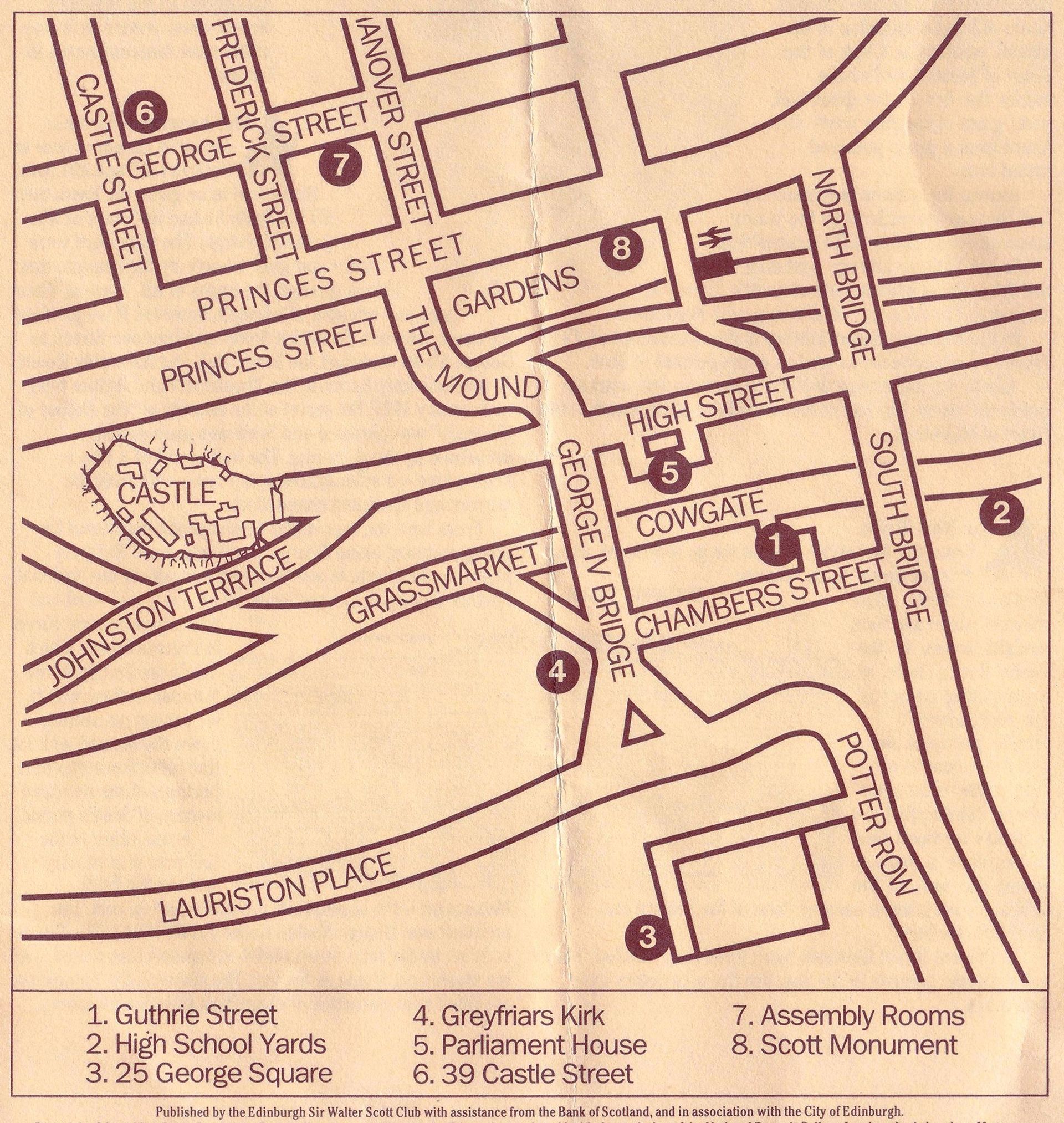

A Sir Walter Scott Walking Tour of Edinburgh 1971
1971
Following in the Footsteps of Scotland’s Greatest Storyteller
In 1971, to mark the bicentenary of Sir Walter Scott’s birth (1771–1832), the Edinburgh Sir Walter Scott Club produced a small guide to the city he helped immortalise. Distributed free of charge — with a modest £50 contribution from the Scottish Tourist Board — it traced the principal places in Edinburgh associated with Scott’s life and work.
More than fifty years later, that route remains one of the richest literary walks in Europe.
This tour invites you to retrace those steps — from the closes of the Old Town to the ordered elegance of the New Town — through the city that shaped Scott, and which he in turn helped define for the world.
Parliament House & St Giles’ Cathedral
The Working Lawyer
Before he became the most celebrated novelist in Europe, Scott was first and foremost a lawyer.
As Clerk of the Court of Session, he spent long hours in Parliament Hall, just behind St Giles’ Cathedral, immersed in legal argument and public affairs. These daily scenes of debate, character and conflict furnished him with a deep understanding of Scottish society — material that would later animate novels such as The Heart of Midlothian.
Within Parliament Hall stands a statue of Scott carved by the young stonemason-sculptor John Greenshields — a fitting tribute in the very space where Scott served with diligence and distinction.
Nearby, the National Library of Scotland holds original manuscripts of Marmion, Waverley, The Heart of Midlothian, and Redgauntlet. In the adjoining Signet Library is the manuscript of The Bride of Lammermoor, along with a fine portrait of Scott. Few cities can so closely unite the places of creation and preservation.
Greyfriars & the Old Town
Gravestones and Imagination
Scott loved the Old Town — its closes, its kirkyards, its sense of layered history.
Greyfriars Kirkyard, with its weathered stones and Covenanter associations, embodies the atmosphere that fed his romantic imagination. Here the past feels near at hand. It is easy to see how such surroundings nurtured the dramatic historical sensibility that became Scott’s hallmark.
Other Old Town associations include High School Yards, where Scott was educated, and Canongate Churchyard, rich in literary and historical memory. Guthrie Street and the surrounding streets remind us how closely Scott’s life was interwoven with this part of the city.
High School Yards
The Young Scott
Scott attended the Royal High School. A childhood illness left him lame, yet it also fostered habits of reading and reflection. Deprived of vigorous play, he turned instead to ballads, legends and border tales.
In these formative years began his lifelong devotion to Scotland’s history and oral tradition — foundations upon which his poetry and fiction would later be built.
25 George Square
The Student Years
As a law student at Edinburgh University, Scott lodged in George Square.
The Enlightenment capital buzzed around him: philosophers, advocates, men of letters. Though Scott would later become the great romanticiser of Scotland’s past, he was formed in this rational, intellectually rigorous climate. The blend of romance and reason that marks his writing owes much to these student years.
The Mound & Princes Street Gardens
Scott’s Edinburgh in View
From the foot of the Mound, walk west along Princes Street and pause.
To the south rises the Old Town ridge — medieval, irregular, storied.
To the north stretches the New Town — ordered, Georgian, Enlightenment.
Scott loved both. He understood both. In many ways, he embodied the bridge between them.
Princes Street Gardens, private in his day, were nevertheless open to him; the proprietors gave him a key. He strolled there frequently, beneath the Castle Rock he knew so well.
39 Castle Street
“Dear 39”
Scott lived at 39 Castle Street from 1802 until the financial crash of 1826.
“Dear 39,” he called it.
Here, in the summer of 1814, Waverley was published. From a back window overlooking George Street, John Gibson Lockhart recalled seeing Scott seated at his desk, unremittingly filling page after page of manuscript.
From this address flowed the Waverley Novels — including Guy Mannering, The Heart of Midlothian, Rob Roy, and Redgauntlet. Alongside his beloved Abbotsford, this house ranks among the most significant literary addresses in Europe.
The Assembly Rooms
The Great Reveal
In 1826 financial disaster struck. Scott’s publishers collapsed, and with them much of his fortune. 39 Castle Street had to be relinquished.
From then until his death in 1832, Scott had no house of his own in Edinburgh. He lived in various residences, including Mrs Brown’s lodgings at 5 North St David Street, 3 Walker Street, with his publisher Robert Cadell at 16 Atholl Crescent, and, on his final return from Italy in 1832, at the Douglas Hotel near St Andrew Square.
Yet it was in the Assembly Rooms that one of the most dramatic moments of his career unfolded. At a Theatrical Fund Dinner in February 1827, Scott publicly acknowledged that he was “The Author of Waverley.” The secret he had guarded for years was revealed, and he was greeted with uproarious acclaim.
Even amid ruin, he stood honoured.
The Scott Monument
Edinburgh’s Gothic Tribute
Rising from Princes Street Gardens, the Scott Monument remains one of the most striking literary memorials in the world.
Designed by George Meikle Kemp (1795–1844), it houses a seated statue of Scott by Sir John Steell (1804–91), with his beloved deerhound Maida at his feet. The monument’s niches contain dozens of carved figures representing characters from Scott’s novels — a stone gallery of his imagination.
It is not merely a memorial. It is a sculpted testament to the breadth of his creative vision.
The Final Years
Scott’s response to financial collapse was characteristically resolute. He refused bankruptcy and undertook to repay his debts through writing. The final years of his life were marked by relentless labour, declining health, and extraordinary dignity.
He died in 1832.
What he left behind was more than poetry and novels. Through his storytelling, he reshaped Scotland’s image — both at home and abroad. He revived interest in the nation’s past, dignified its traditions, and placed its history at the centre of European literature.
The 1971 bicentenary guide traced these places in modest form, made possible by a small Tourist Board contribution and the dedication of the Edinburgh Sir Walter Scott Club. The route remains as compelling today as it was then.
To walk it is not merely to follow a map.
It is to step into the landscape of a literary imagination that helped define a nation.