
An Evening at Abbotsford
Friday 30th September 1994
Summary of the Event:
As part of the wider Centenary Celebrations members of the Club were invited to a buffet supper at Abbotsford.
Performances by:
Tom Fleming - Excerpts from Wandering Willie's Tale
Martyn Bennett and Margaret Bennett - Scottish Songs and Ballads
- The Braes of Mellinish,
- The Snuff Wife
- Troy’s Wedding
- The Dowie Dens o' Yarrow
- Glenfinlas
- MacCrimmon's Lament
- The Border Widow's Lament
- Caidil Gu Là (Sleep Till Daybreak)
- Bonnie Dundee
- Fiddle Set
- Jock O’Hazeldean
With his usual impeccably awful timing, the Chairman was abroad, but the event was by all accounts a huge success. Presiding over the occasion was the Club's Secretary, Fraser Elgin, whose leadership had helped maintain the close relationship between the Club and the Scott family at that time.
Club member Tom Fleming, the greatly admired actor and commentator, brought alive so vividly the characters from Wandering Willie's Tale that the audience sat enthralled, while the musical part of the evening entertainment was aptly chosen and delightfully rendered by another of the Club's talented members acclaimed folklorist, singer and scholar Margaret Bennett and her late son Martyn Bennett, over the following decade he would become one of Scotland's most innovative and influential performers, blending traditional music with contemporary sounds and reaching new audiences worldwide. These recordings capture Martyn performing alongside his mother long before his later international acclaim.
Drawing upon both Highland and Border traditions, Margaret and Martyn presented a programme of songs, tunes and stories associated with Sir Walter Scott and the cultural heritage that inspired his work. Their performances ranged from ancient Gaelic songs and Border ballads to Scott's own compositions, illustrating the rich tapestry of traditions that Scott collected, celebrated and helped preserve for future generations.
These recordings capture not only a memorable musical performance but also a unique occasion in the life of the Club, held within the walls of Abbotsford itself and in the company of Scott's descendants. They offer a fascinating glimpse of Scottish traditional culture as interpreted by two of its finest ambassadors.
01. Martyn Bennett (Scottish Small Pipes): Tune Set -
The Braes of Mellinish, The Snuff Wife and Troy’s Wedding
Lively pipe tunes from the Scottish traditional repertoire, performed here by Martyn Bennett on the Scottish small pipes. Although not directly connected with Sir Walter Scott, tunes of this type formed part of the living musical tradition that Scott encountered during his travels throughout the Highlands and Borders. The performance provided a fitting musical opening to an evening celebrating Scotland's literary and cultural heritage.
Scottish Small Pipes: The Scottish small pipes are a quieter, bellows-blown relative of the Highland bagpipe. Their mellow tone makes them particularly suited to indoor performance and accompaniment.
02. Margaret Bennett: Introduction to The Dowie Dens o' Yarrow
03. Margaret Bennett: The Dowie Dens o' Yarrow
One of the great Border ballads collected by Sir Walter Scott in Minstrelsy of the Scottish Border (1803). The song tells of a young man ambushed and killed by rivals on the banks of Yarrow Water in the Scottish Borders. Scott helped preserve the ballad and its association with the Yarrow valley remains strong today. Multiple variants exist, with at least nineteen versions recorded by Francis James Child.
04. Margaret Bennett: Introduction to Glenfinlas
05. Margaret Bennett (vocal) Martyn Bennett (piano): Glenfinlas
Glenfinlas began life as a narrative poem by Sir Walter Scott, first published in 1792 and among the earliest works that established his reputation as a poet. Set in the wild landscape of the Trossachs, the poem draws upon Highland folklore and supernatural tradition to tell the story of a hunter who encounters a mysterious woman in the hills, with tragic consequences.
The poem reflects Scott's lifelong fascination with Scotland's legends, oral traditions and dramatic landscapes. Drawing upon tales that he heard during his travels, Scott combined folklore with romantic storytelling to create a vivid and atmospheric work that helped shape popular perceptions of the Highlands during the nineteenth century.
Although originally written as a poem rather than a song, Glenfinlas has subsequently been adapted for musical performance. Its inclusion in this programme illustrates the close relationship between literature and song in Scottish tradition, where poems were frequently sung and songs often preserved stories that might otherwise have been forgotten.
06. Margaret Bennett: Scott's Visit to Skye and Introduction to MacCrimmon's Lament
07. Margaret Bennett: MacCrimmon's Lament (Gaelic Version)
One of the most famous melodies in the Highland musical tradition, MacCrimmon's Lament is associated with the legendary MacCrimmon family, hereditary pipers to the Chiefs of MacLeod at Dunvegan Castle on Skye. Tradition holds that the tune was composed as a farewell before battle, though several versions of the story exist.
Sir Walter Scott played an important role in popularising Highland history and culture, and tales of the MacCrimmons were widely known among nineteenth-century audiences. Margaret Bennett's performance of the Gaelic version reflects the song's deep roots in the oral traditions of the Highlands and Islands.
Audience members joined in the chorus, recreating the communal spirit in which such songs were traditionally performed.
08. Margaret Bennett: Introduction to The Border Widow's Lament
09. Martyn Bennett (viola): Joke about Tuning
10. Margaret Bennett (vocal) Martyn Bennett (viola; arranger): The Border Widow's Lament
The Border Widow's Lament is one of the most moving songs preserved in the Scottish Borders tradition. The ballad tells the story of a young widow whose husband has been killed during a cattle raid. Left alone in the wilderness, she carries his body home, prepares his grave and buries him with her own hands before lamenting her loss.
The song offers a rare and powerful female perspective on the violence that characterised life along the Anglo-Scottish frontier for centuries. While many Border ballads celebrate raids, feuds and acts of daring, this song focuses on the personal cost of such conflicts and the grief endured by those left behind.
Sir Walter Scott recognised the importance of the ballad and included it in Minstrelsy of the Scottish Border. He regarded it as one of the finest examples of traditional Border poetry. Through Scott's collection, the song survived at a time when many ancient ballads were disappearing from popular memory.
Margaret Bennett's performance brings renewed life to a song that remains one of the most poignant expressions of loss in Scottish traditional music.
11. Margaret Bennett: Introduction to Scott's daughter Sophia who learnt a song in Skye
12. Margaret Bennett: Caidil Gu Là (Sleep Till Daybreak)
This traditional Gaelic lullaby was learned by Sir Walter Scott's daughter Sophia during a visit to Skye and became one of the songs associated with the Scott family. Its inclusion in the programme reflects the close connection between Scott's family and the Gaelic culture of the Highlands.
The gentle melody and soothing words are characteristic of Highland cradle songs, preserving a tradition that was passed from generation to generation through oral transmission. Margaret Bennett's performance highlighted both the beauty of the Gaelic language and the rich musical heritage that fascinated Scott throughout his life.
13. Margaret Bennett: Introduction to Bonnie Dundee
14. Margaret Bennett (vocal) Martyn Bennett (piano): Bonnie Dundee
Bonnie Dundee is among the best-known songs associated with Sir Walter Scott. Written to an existing traditional melody, Scott's verses celebrate John Graham of Claverhouse, Viscount Dundee, the Jacobite hero who remained loyal to King James VII during the political upheavals of the late seventeenth century.
The song takes the form of a stirring call to arms as Dundee rallies his supporters before riding north to raise the Jacobite standard. Scott's vivid language and memorable chorus transformed the older tune into one of Scotland's most popular patriotic songs. It quickly entered the national repertoire and remains widely performed today.
Scott's portrayal of Dundee reflects the romantic spirit that characterises much of his writing. Although historians continue to debate the legacy of Claverhouse, Scott's song helped establish the image of "Bonnie Dundee" as one of the great heroic figures of Scottish history.
For this performance, Martyn Bennett accompanied on piano while the audience joined in the singing, creating a communal musical experience of the kind that has long been central to Scottish social and cultural life.
15. Margaret Bennett: Introduces Martyn as he tunes his fiddle.
16. Martyn Bennett: Fiddle Set (Old Style)
Following the vocal items, Martyn Bennett performed a set of traditional fiddle tunes in the older Scottish style. Such tunes formed the soundtrack of everyday life in Scotland for centuries, accompanying dances, gatherings and celebrations.
At the time of this performance, Martyn was already displaying the extraordinary musicianship that would later establish him as one of the most innovative figures in Scottish music. His ability to move effortlessly between pipes, fiddle, viola and piano reflected the breadth of Scotland's musical traditions.
17. Margaret Bennett: Introduction to Jock O’Hazeldean
18. Margaret Bennett (vocal) Martyn Bennett (small pipes): Jock O’Hazeldean
A ballad written by Sir Walter Scott and first published in 1818. It tells the story of a young woman pressured into an advantageous marriage who instead elopes with her true love, Jock of Hazeldean. It became one of Scott's most successful songs and remains popular with singers today.
19. Vote of Thanks
Note: Published with permission of Dr. Margaret Bennett
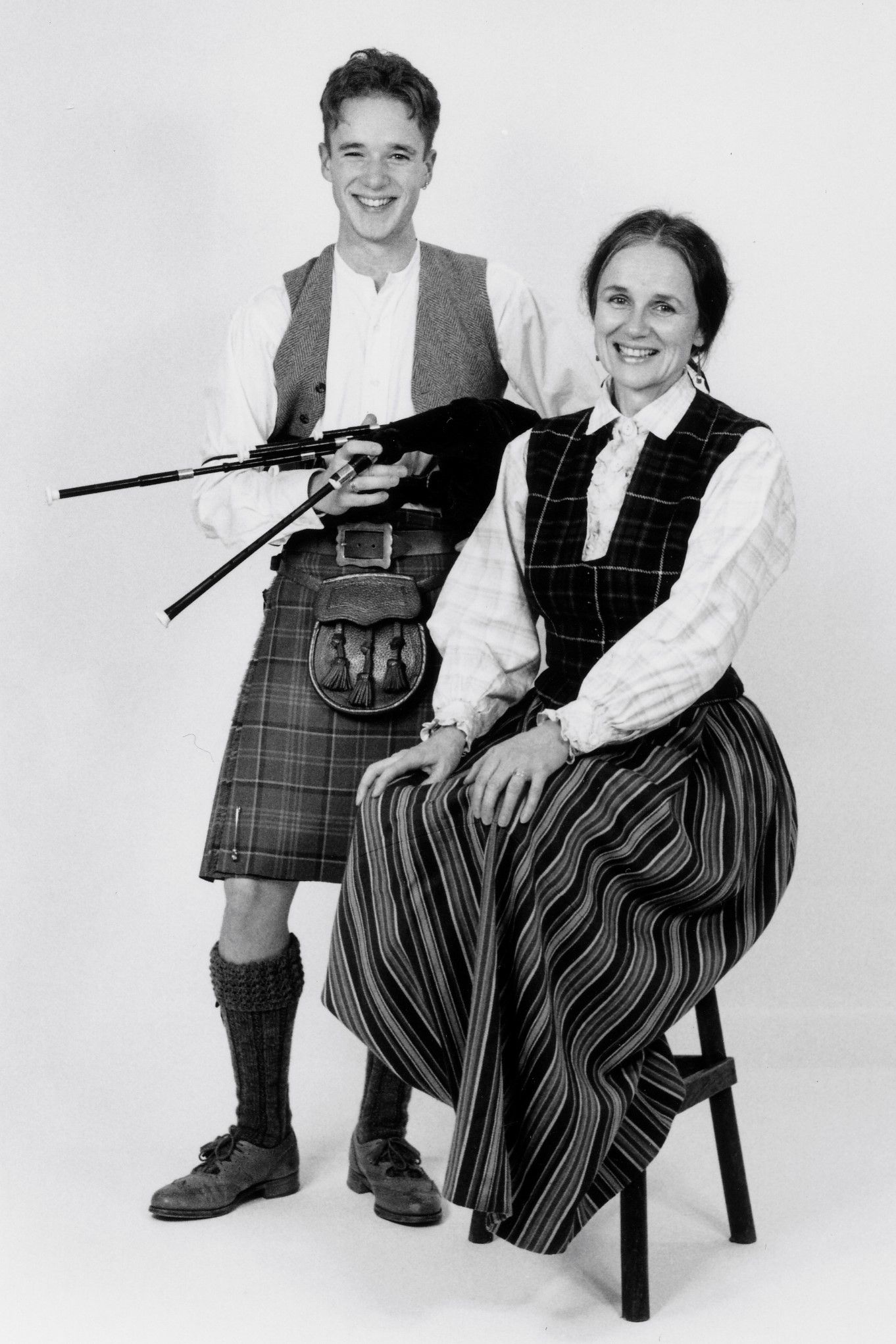
Martyn and Margaret. Image Credit: Ian MacKenzie, photographer at the School of Scottish Studies
20: Complete Audio Recording
One of the lovely things about the evening is that it reflects exactly the kind of entertainment Scott enjoyed. Abbotsford's drawing room was regularly used for songs, recitations and storytelling during Scott's lifetime. Visitors frequently recorded evenings of music and ballad singing there.
This recording captures Martyn Bennett at the age of 23, more than a decade before his death in 2005. Widely regarded as one of the most innovative figures in Scottish music, Bennett transformed perceptions of traditional music through groundbreaking albums including Bothy Culture, Hardland and Grit. This performance offers a rare opportunity to hear him in an intimate setting alongside his mother, folklorist Margaret Bennett, early in his career.
Planning the Event: Letters to the Secretary.
Correspondence recently rediscovered among Margaret Bennett's papers reveals that planning for the evening began almost a year in advance. Writing in November 1993, Club Secretary Fraser Elgin invited Margaret and Martyn Bennett to perform at Abbotsford, outlining a programme that would combine readings from Scott with traditional music. Following the event, Fraser wrote to express the Club's appreciation, describing it as "a memorable occasion" and noting that Patricia Maxwell-Scott and Dame Jean Maxwell-Scott were "absolutely delighted with it all."
30 November 1993 — Fraser Elgin to Margaret Bennett
Fraser writes:
"I was delighted to get your phone call last week-end and to hear that you will be able to be with us at Abbotsford on Friday, Sept. 30th, 1994 and to entertain us with some appropriate music that evening."
He also mentions Martyn specifically:
"I am delighted to offer him £50 for the evening. I do hope he will be able to accept our offer."
The letter goes on to outline the proposed format of the evening:
"The evening would consist of readings possibly from Wandering Willie's Tale, we hope by Tom Fleming, and your presentation of, I imagine, ¾ to 1 hour. Either afterwards or between the two presentations there would be wine and a buffet supper."
15 March 1994 — Fraser Elgin to Margaret Bennett
Fraser writes:
"I saw Patricia Maxwell-Scott last week and she is already talking about September. We are both determined to make it another great occasion..."
and
"Once we get a bit nearer the date I will be in touch to discuss the programme."
4 October 1994 — Fraser Elgin to Margaret Bennett
Fraser writes:
"I felt I had to put in writing the very real appreciation of all the members present for the musical part of what proved to be a memorable occasion."
He specifically praises Margaret and Martyn:
"Both your and Martyn's contribution to the programme fitted in so well and it was lovely that you managed to get such an audience to join in the singing."
He continues:
"The whole evening was a source of utter enjoyment."
and notes:
"Patricia and Jean were absolutely delighted with it all."
Perhaps most interestingly, he reveals that the running order changed:
"On reflection I am sure that the re-arrangement of the programme was a considerable improvement..."
Programme 1994
The Club programme included:
Friday, September 30th 1994 — Visit to Abbotsford with readings from Scott and recital by Margaret Bennett.
