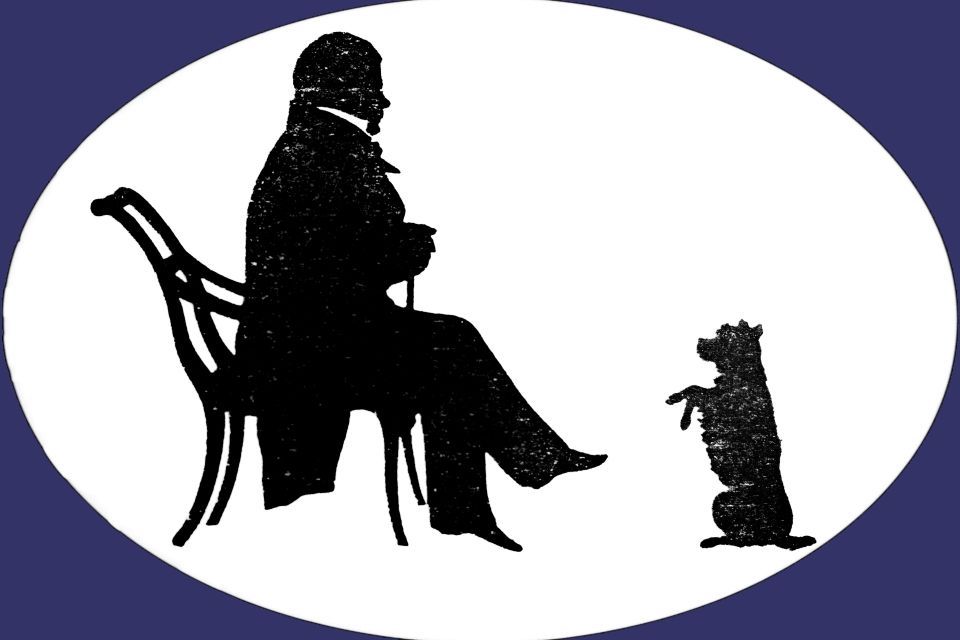

King Dan and the King’s man: Daniel O’Connell and Sir Walter Scott
Tuesday 21st April 2026
Summary of the Talk:
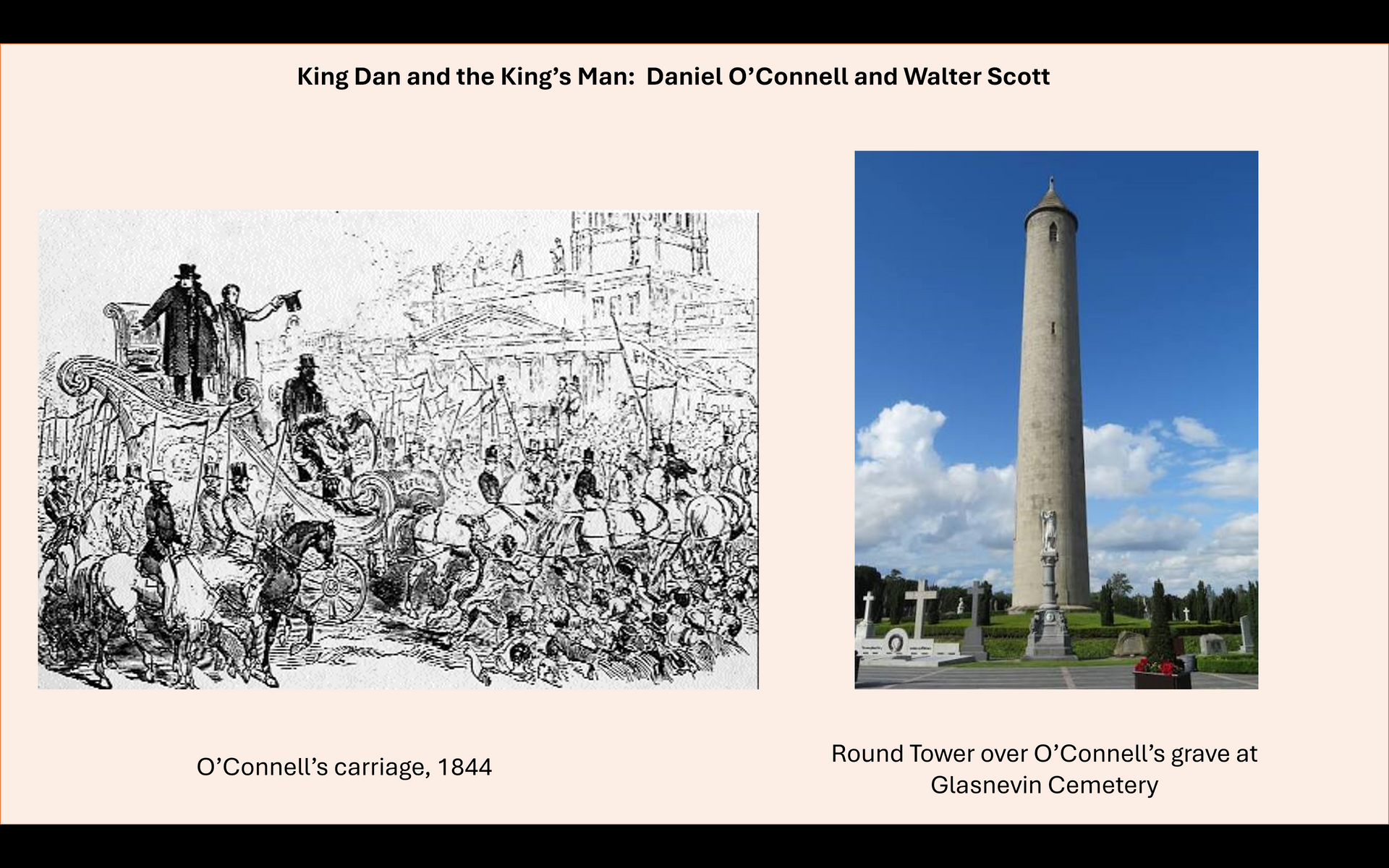
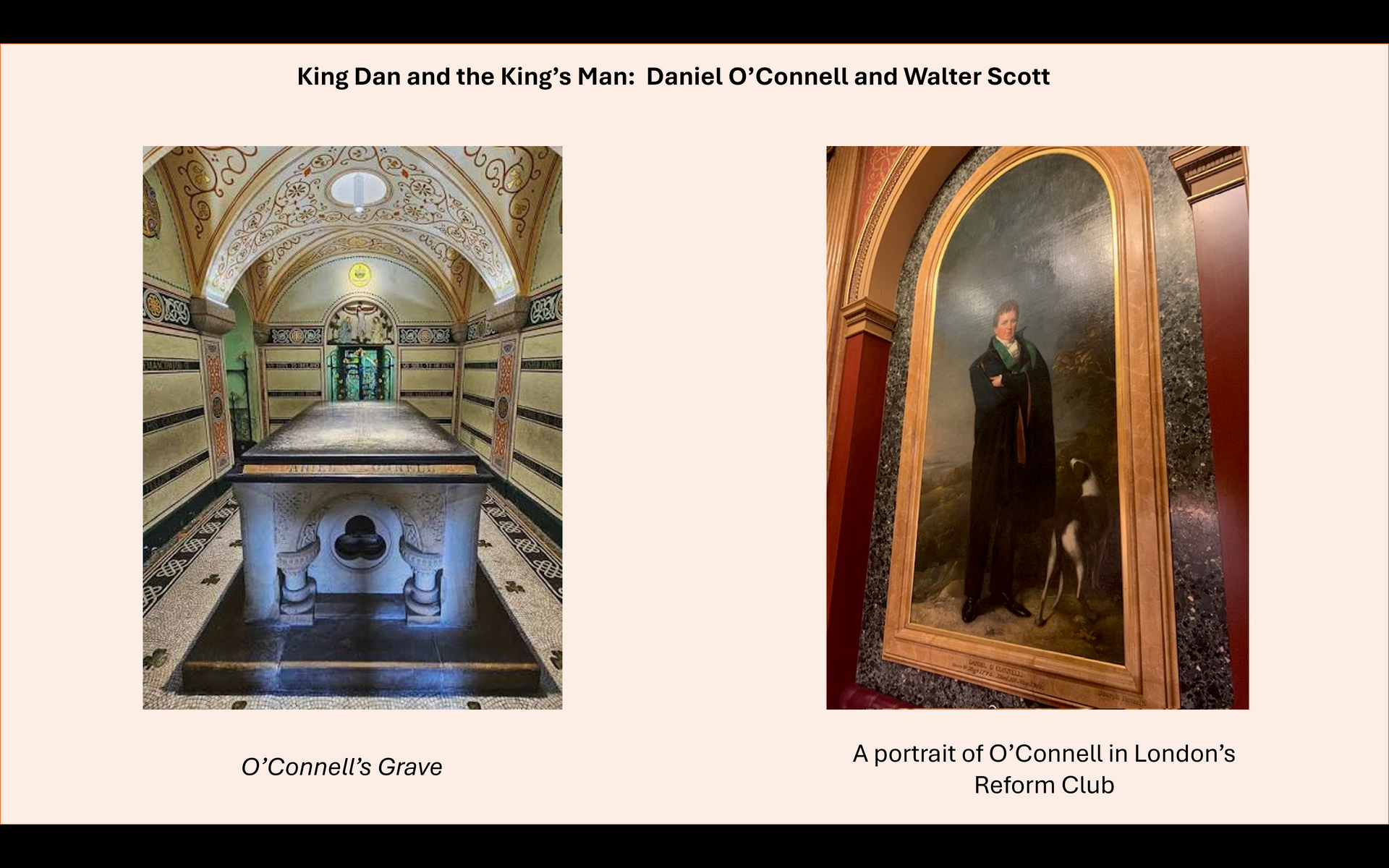
Dan Mulhall’s central argument was that Daniel O’Connell and Sir Walter Scott were two of the most important public figures of nineteenth-century Ireland and Scotland respectively, and that comparing them helps explain the different political and cultural paths taken by the two countries. O’Connell, born in 1775 in remote County Kerry, became the dominant Irish political figure of the first half of the nineteenth century and, in Mulhall’s view, perhaps the most prominent Irishman of the entire century. Scott, four years older, occupied a similarly towering place in Scottish public life and enjoyed an international reputation through his novels and public influence.
The lecture stressed both similarities and contrasts. Both men came from relatively privileged backgrounds, trained as lawyers, achieved fame beyond their own countries, and were often financially strained. Both also had a horror of political violence, shaped in O’Connell’s case by his experience of the French Revolution and in Scott’s by his deeply conservative reaction to revolution and disorder. Yet they drew very different conclusions from that shared aversion. O’Connell believed reform could and must be won peacefully, through agitation, legal argument and parliamentary pressure. Scott, by contrast, was instinctively conservative and deeply suspicious of radical political change.
Mulhall explored O’Connell’s achievement in securing Catholic Emancipation in 1829, which earned him the titles “King Dan” and “The Liberator”. He argued that O’Connell became important not only in Ireland but across Europe because he seemed to demonstrate that major reform could be achieved without revolution. Scott, meanwhile, rarely engaged directly in party politics, but played a major role in Scottish civic life, especially through orchestrating George IV’s visit to Scotland in 1822. Both men also understood spectacle and pageantry, though they used it for different ends.
A particularly interesting theme was O’Connell’s admiration for Scott. Mulhall noted that O’Connell eagerly read Scott’s novels and even reread the entire set in 1841, declaring that there had never been such a novelist and never would be again. Scott, however, seems never to have formed any real connection with O’Connell. There is no strong evidence that the two men ever met, despite overlapping periods of prominence and Scott’s visit to Ireland in 1825. Mulhall suggested that they moved in different political circles and would likely have regarded each other with a mixture of interest and caution.
The lecture’s most striking contrast lay in culture rather than politics. Scott used literature, history and tradition to preserve and define Scottish national identity in cultural terms, even within the Union. He was deeply attached to Scottish institutions, resisted attempts to anglicise Scottish law and banking, and helped maintain a distinct sense of Scottish nationhood without demanding political separation. O’Connell, by contrast, though Irish-speaking by background and rooted in Gaelic Ireland, showed comparatively little interest in preserving or reviving native Irish culture. His concern was political and practical: improving conditions for Irish Catholics, reforming Parliament, and restoring an Irish legislature. Later Irish nationalists would criticise him for that, especially those involved in the Gaelic Revival and cultural nationalism.
Mulhall argued that this difference mattered historically. Scotland developed a strong cultural nationalism without a serious push towards independence for much of the modern period, whereas Ireland developed a much more politically charged relationship with the Union. He suggested that O’Connell helped set Ireland on a path of constitutional discontent that eventually led, after famine, Home Rule failure and war, towards independence. Scott, in contrast, helped shape a Scotland that remained culturally distinct while politically within the Union.
In the questions, discussion turned to Thomas Moore, the Irish poet and songwriter, who was known to Scott and occupied an interesting middle ground between Irish nationalism and London society. Mulhall also reflected further on why O’Connell, unlike Scott, did not make greater use of national history and legend. He suggested that O’Connell’s cast of mind was intensely practical and lawyerly: he saw politics as a matter of solving immediate problems rather than invoking a romanticised national past. In this, one audience member observed, O’Connell looked forward, seeking practical improvements in ordinary life, whereas Scott looked backwards, preserving memory and tradition.
Interesting points worth mentioning
One of the strongest points in the lecture was the idea that O’Connell mattered far beyond Ireland because he offered Europe a model of peaceful reform. Mulhall made the case that liberals across Europe watched him closely because he appeared to prove that one could pursue major constitutional change without ending in bloodshed or revolution.
Another particularly interesting detail was that O’Connell greatly admired Scott’s fiction, even though politically they stood very far apart. That admiration adds an unexpected layer to the relationship: O’Connell embraced Scott’s imaginative reconstruction of Scotland’s past, but did not attempt anything comparable for Ireland.
Mulhall’s discussion of cultural identity was also very strong. His contrast between Scott as a guardian of national culture and O’Connell as a pragmatic political reformer feels like the lecture’s sharpest insight. It helps explain why Scottish national feeling and Irish national feeling developed so differently during the nineteenth century.
His remarks on monarchy and pageantry were also revealing. Both Scott and O’Connell understood the symbolic power of ceremony, royal visits and public display, even though their politics diverged sharply. That gives the lecture a useful human dimension: both men understood that public life was not only about laws and ideas, but also about theatre.
A memorable point from the Q&A was Mulhall’s suggestion that later Irish cultural nationalists, including the Young Ireland movement and later revivalists, were in some ways closer to Scott than to O’Connell in their use of history, legend and literature. That is a clever and slightly surprising comparison.
Finally, the lecture seems to have offered a strong overarching claim: that Scott and O’Connell did not simply reflect their nations, but helped map out the distinct political and cultural pathways that Scotland and Ireland continued to follow long after both men had died.
Download the [transcript]
Introduction by David McClay:
Daniel Mulhall is a retired Irish Ambassador now living in Edinburgh. He was Ireland’s first Consul General in Scotland and subsequently served as Ireland’s Ambassador in Kuala Lumpur, Berlin, London and Washington.
Upon retirement in 2022 he was appointed by New York University their global distinguished professor in Irish studies, teaching an undergraduate seminar, "Literature as History: Ireland 1880-1940". He is also a Parnell Fellow at Magdalene College, Cambridge.
He has published many books, the most recent Pilgrim Soul: W.B. Yeats and the Ireland of his Time (Dublin, 2023). He is also past honorary president of the Yeats Society.
Download the [transcript]
