
Scott’s View from the Wicks of Baiglie
1935
The Edinburgh Sir Walter Scott Club and the preservation of a forgotten panorama
When people speak of “Scott’s View”, they usually mean the famous vista near Bemersyde in the Borders. Yet Sir Walter Scott himself praised another prospect — one he described as “one of the most beautiful points of view in Britain.”
This is the view from the Wicks of Baiglie, reached by the old Wallace Road above Glenfarg, on the slopes of Dron Hill.
Scott and the Wallace Road
In 1796, Scott travelled north using the Wallace Road to reach Invermay. The memory of that journey stayed with him. In the opening pages of The Fair Maid of Perth, he evokes the prospect from this height — looking across the hills and straths around Perth and onward towards the Highlands.
Importantly, the “Wicks of Baiglie” refers not simply to the road that now bears that name (which lies some distance east), but to a specific summit viewpoint on Dron Hill.
For many years the spot was physically marked with a plaque identifying it as Scott’s View. Today, only fragments of iron- and stone-work survive.
The Club’s Involvement in 1935
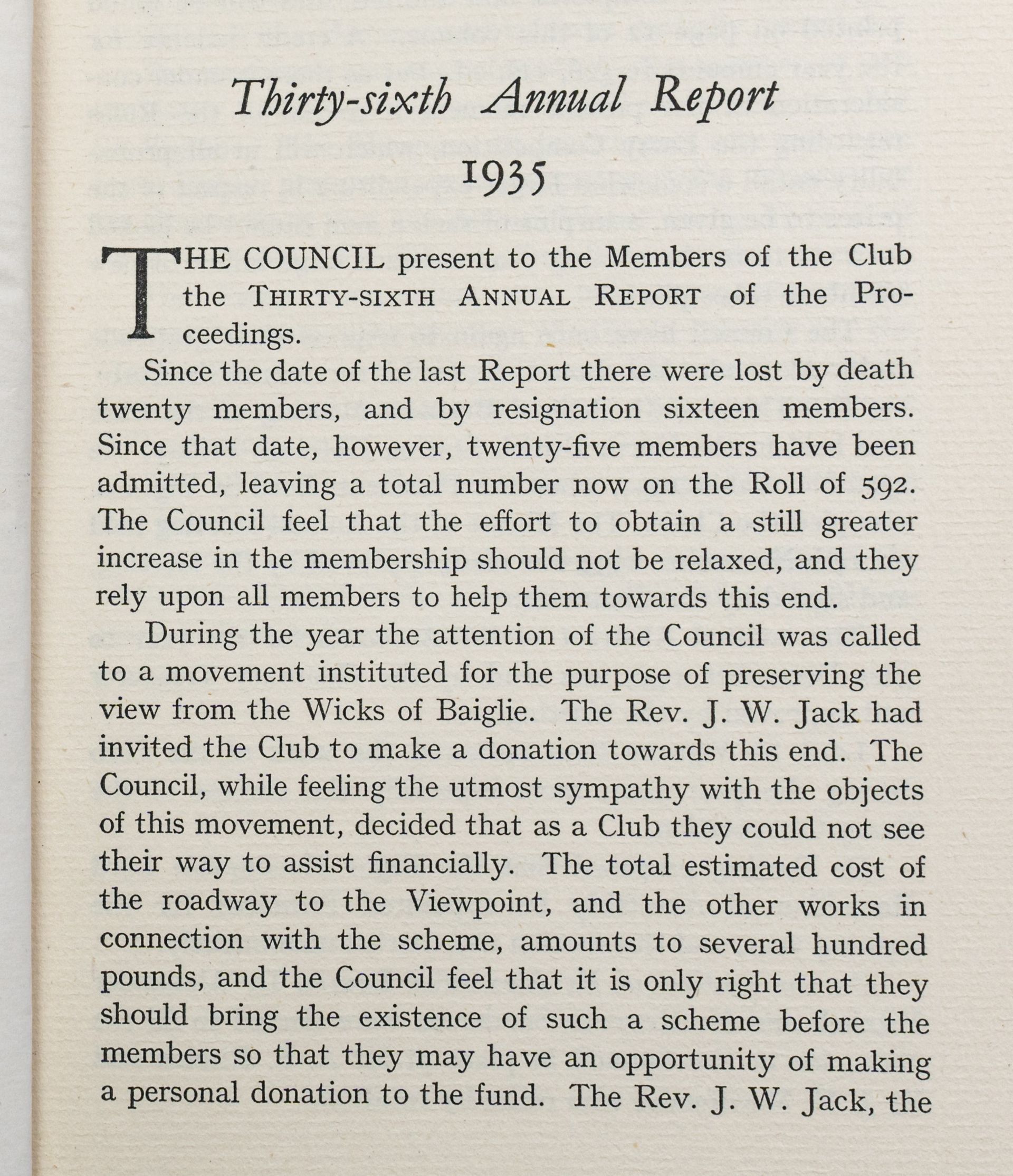
In the Thirty-Sixth Annual Report (1935) of the Edinburgh Sir Walter Scott Club, members were informed of a movement to preserve the view from the Wicks of Baiglie.
The initiative appears to have been associated with the Rev. J. W. Jack, who had written on the subject in 1933. That same year he published a booklet titled Scott’s View from the Wicks of Baiglie, discussing the roads and the viewpoint.
By 1935, a scheme was underway which included:
- Preserving the outlook itself
- Providing or improving access
- Constructing a roadway to the viewpoint
- Meeting an estimated cost amounting to several hundred pounds
The Club made the project known to members so that personal donations could be made.
This was not merely antiquarian enthusiasm. It was practical landscape stewardship — protecting a specific literary prospect associated with Scott’s imagination.
That a plaque once stood there strongly suggests that the scheme bore fruit.
Reaching Scott’s View (Wicks of Baiglie)
The viewpoint lies on Dron Hill, above Glenfarg, in Perthshire (now Perth and Kinross).
Starting Point
A practical approach is from the Glenfarg area, accessing the old Wallace Road. Modern walkers often use routes described by ScotWays (Heritage Path HP07).
General Route Guidance
- Begin near Glenfarg and locate the Wallace Road track.
- Follow the historic road uphill towards Dron Hill.
- Near the summit, look westward for the high ground traditionally identified as the Wicks of Baiglie viewpoint.
There is no prominent modern marker. You may notice remnants of old ironwork or stone fittings — thought to be associated with the former plaque marking Scott’s View.
The panorama opens west and north-west:
- The rich agricultural straths around Perth
- Rolling hills beyond
- Distant Highland outlines on a clear day
It is easy to see why Scott remembered it decades later.
A Second “Scott’s View”
It is worth noting that this Perthshire viewpoint is sometimes overshadowed by the more famous Scott’s View in the Borders. Yet the Wicks of Baiglie view is directly embedded in Scott’s own prose.
In some ways, it is the more intimate of the two — tied to his youthful travels and literary recollection.
Why It Matters
The 1935 involvement of the members of the Edinburgh Sir Walter Scott Club shows that the preservation of literary landscapes is not a recent idea. Nearly a century ago, members recognised that:
- Views associated with Scott were culturally significant
- Access and visibility required active care
- Local initiative and voluntary subscription could safeguard heritage
Today the plaque has gone. The ironwork is fragmentary. The road is walked rather than driven.
But the view remains.
And so does the memory of those who acted to preserve it.
If any reader possesses a photograph of the original Dron Hill plaque, or documentary material relating to the 1935 scheme, the Club would be very glad to hear from you.
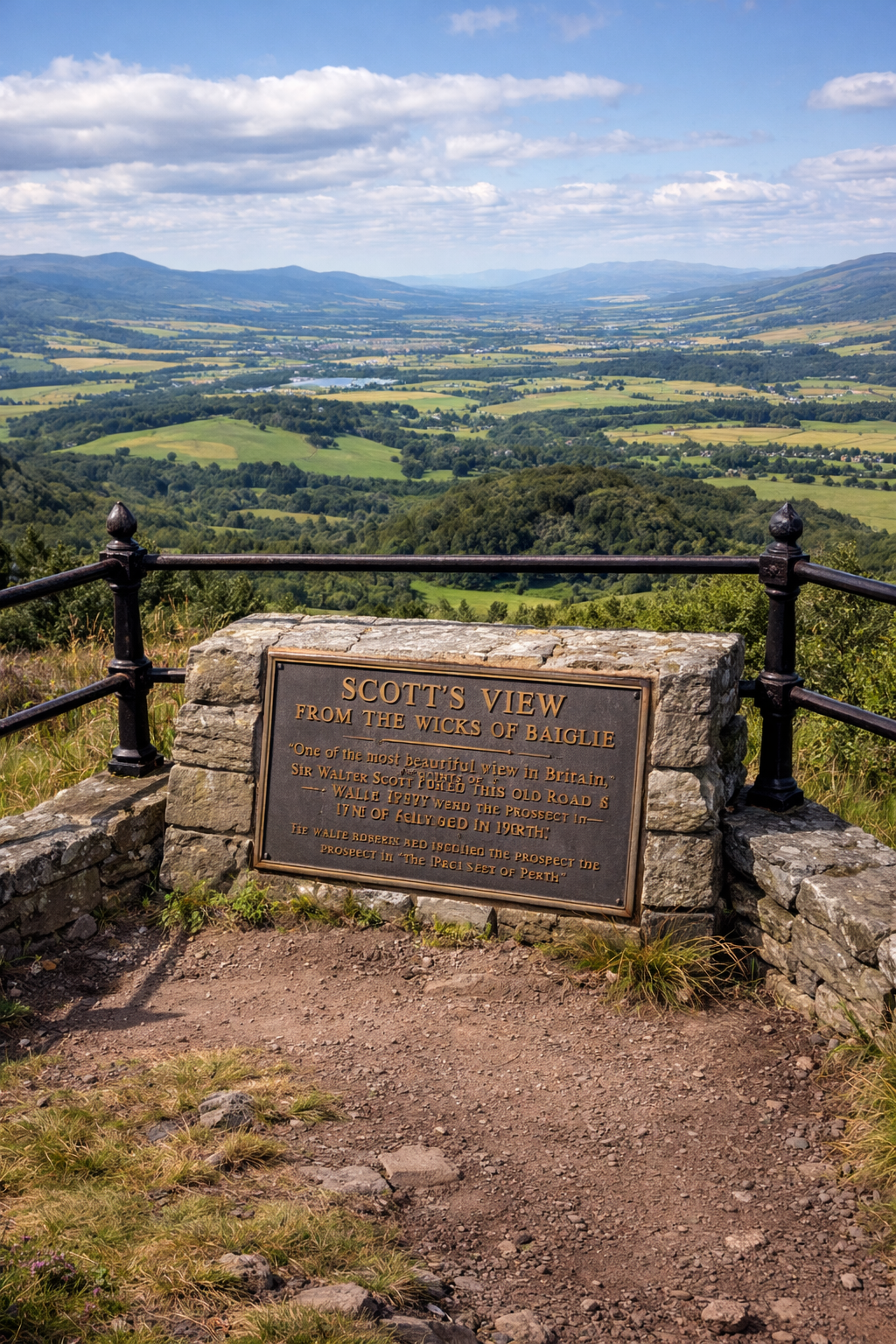
AI generated recreation imagining the plaque in 1935.