
Eildon Hills Indicator
Unveiled 3rd June 1927
The Eildon Mountain Indicator (1925–1927): A Collaborative Tribute to Scott
The Indicator on Eildon Mid Hill, unveiled in June 1927, remains one of the most fitting tributes to Sir Walter Scott. Rather than commemorating him in stone alone, it interprets the very landscape that shaped his imagination.
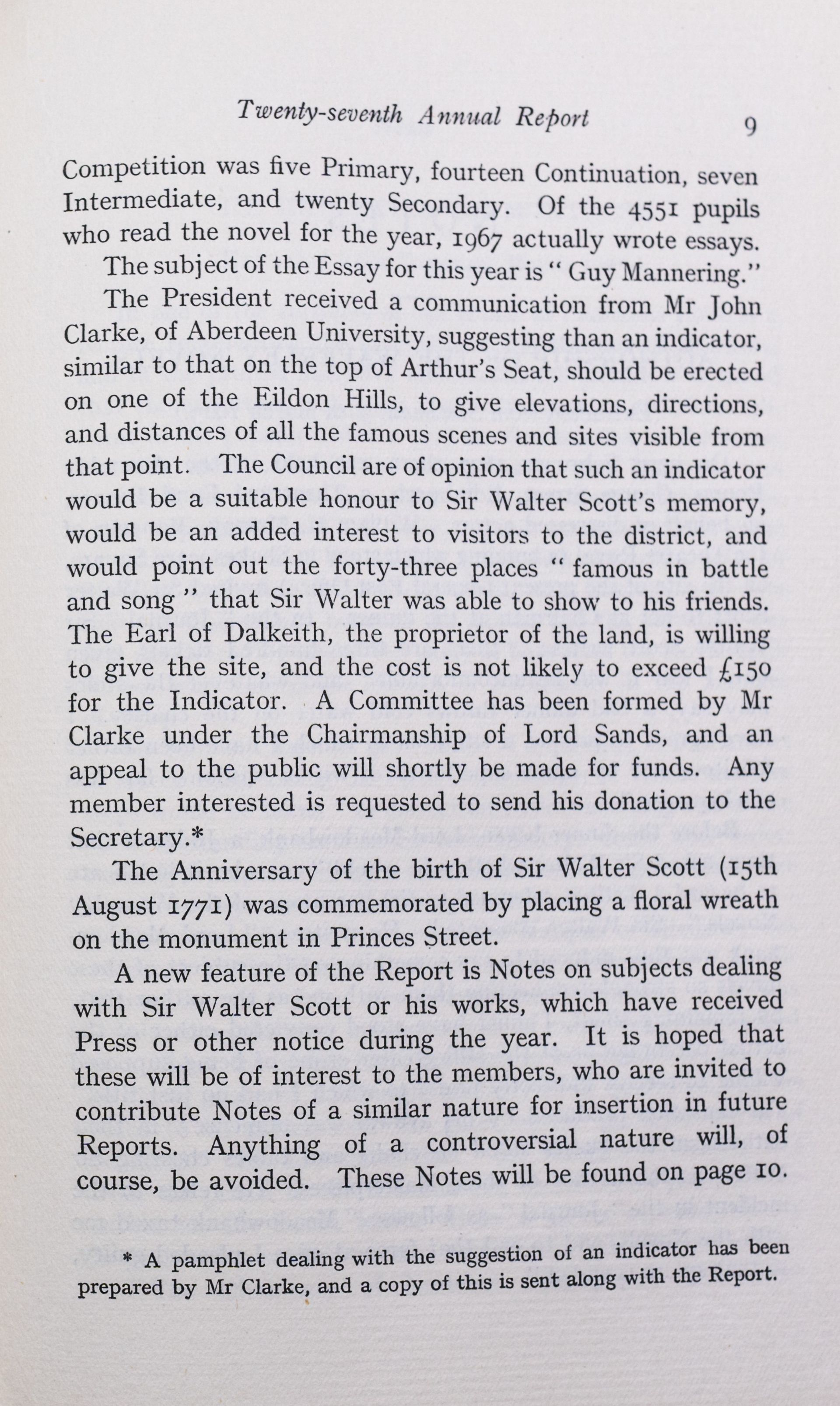
Recent examination of contemporary sources — including the Club’s Twenty-seventh Annual Report and the account published in the History of the Berwickshire Naturalists’ Club — allows us to tell the story more fully and accurately.
The Origin of the Scheme
The idea was first mooted in September 1925.
It came from John Clarke, LL.D., of Old Aberdeen, who had been struck by the absence of any visible record on the hills themselves of the role they played in Scott’s daily life at Abbotsford. Scott was fond of leading guests to the Eildons, from which he could point out the forty-three sites “famous in war and verse”. Yet there was no permanent guide to help visitors identify them.
Clarke did not merely suggest the idea — he became its organiser and secretary. A past President of the Cairngorm Club, he devoted considerable energy to bringing the proposal to fruition.
A Joint Effort
The scheme was not the work of a single body. It was warmly supported by:
- Provost Curle and the Town Council of Melrose
- Lord Dalkeith, who offered the site and material assistance
- The Scott and Border Clubs
- The Edinburgh Sir Walter Scott Club
At the time, Lord Sands, President of the Edinburgh Sir Walter Scott Club, acted as Chairman of the Committee in charge of the project.
The Royal Scottish Geographical Society was also closely involved: George Walker, its Secretary, acted as Treasurer for the scheme.
Subscriptions flowed in — small and large — chiefly from the surrounding district but also from further afield. The total required, a little over £140, was successfully raised.
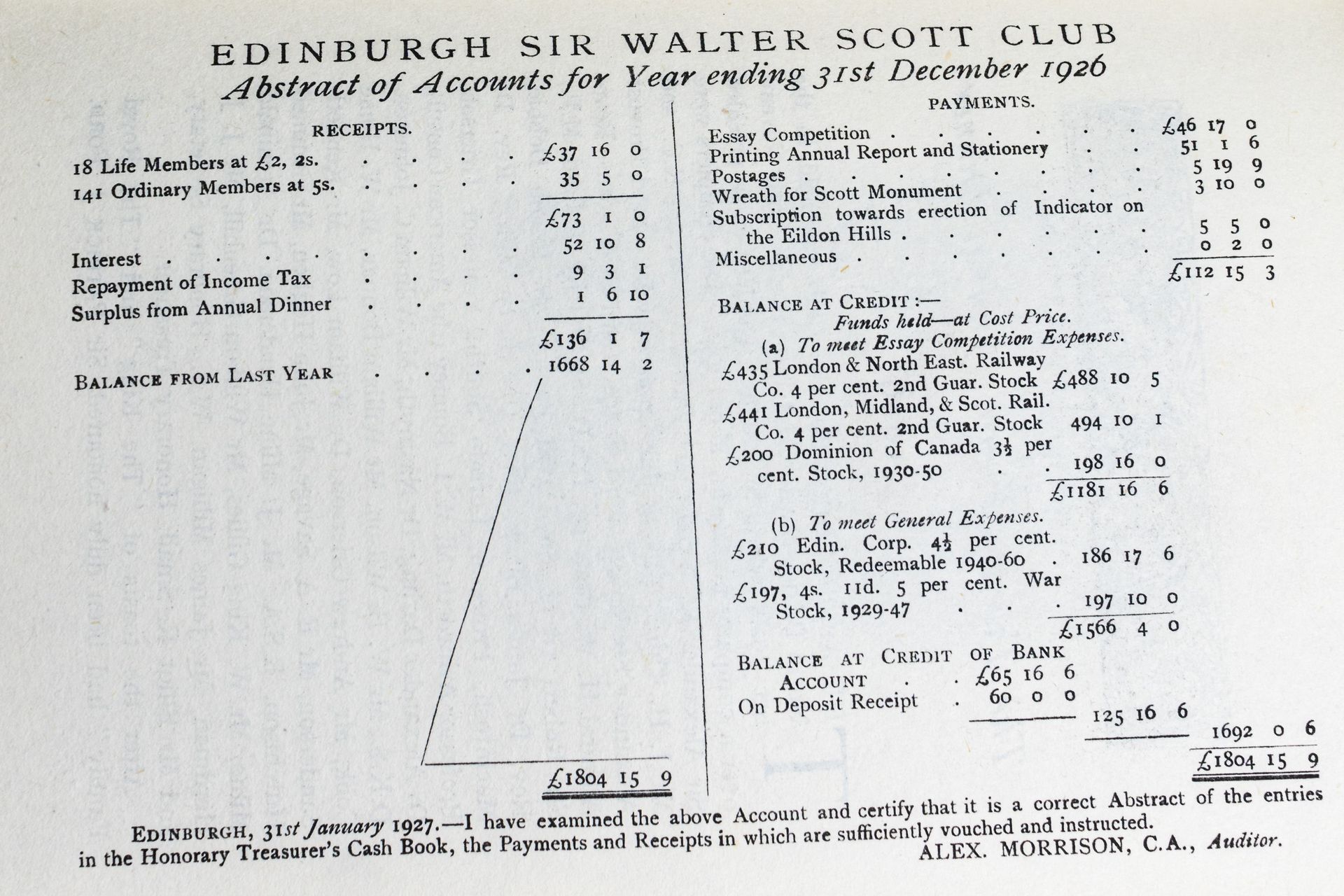
The Club’s own Abstract of Accounts for the year ending 31 December 1926 records a payment of £5 5s 0d “Subscription towards erection of Indicator on the Eildon Hills”, confirming its financial contribution.
The Making of the Indicator
The technical and artistic execution of the Indicator was entrusted to John Mathieson, F.R.S.E., a distinguished geographer, who undertook the survey work, identification of sites, and numerous visits connected with its erection.
The bronze plate forming the index was cast by Charles Henshaw of Edinburgh.
The Aberdeen granite pedestal was the work of
G. Sutherland & Sons of Galashiels.
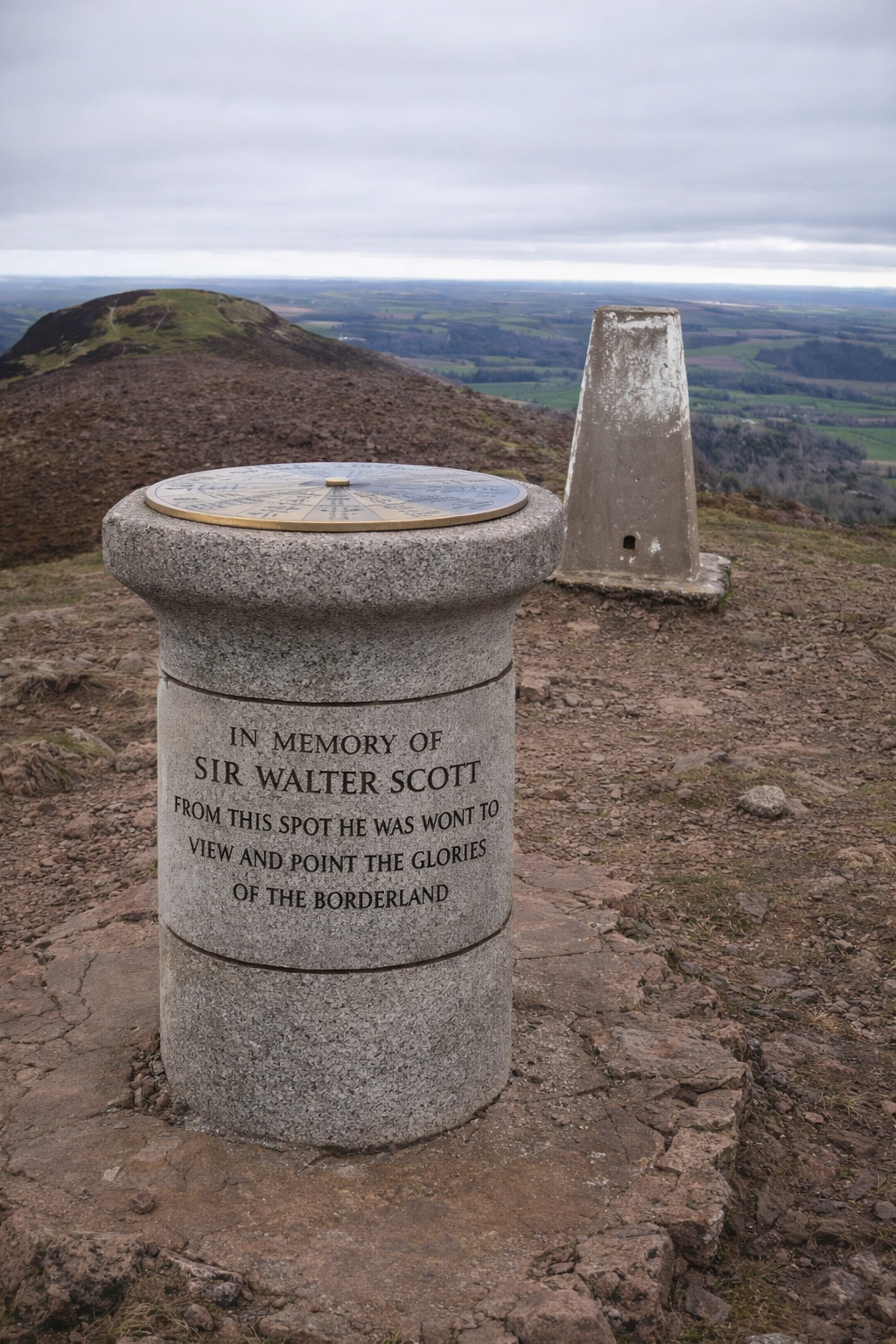
The finished Indicator was more than a simple compass. It became a permanent map of the Border country, showing:
- directions
- distances
- elevations
- and more than double the number of sites pointed out by Scott
It even included important places not directly visible from the summit.
The Unveiling: 3 June 1927
The unveiling took place on 3rd June 1927.
The ceremony was performed by Lord Henry Scott, and the address was delivered by the Master of Polwarth (Captain the Hon. Walter Thomas Hepburne-Scott).
Though the full text of the speech has not yet been located, contemporary accounts describe the occasion as marking not merely the installation of a physical object, but the dedication of a permanent interpretative map of Scott’s Border country. The Indicator was presented as a tribute both to Scott’s genius and to the landscape that inspired it.
In effect, the hills themselves became annotated — a geographical companion to Scott’s poetry and prose.
A Landscape Interpreted
From the summit of Eildon Mid Hill, the view stretches across abbeys, battlefields, rivers, and Lammermuir heights. With the installation of the Indicator, that view was given structure and narrative.
The project stands as an example of early twentieth-century civic collaboration:
- local government
- landowner
- geographical society
- literary clubs
- and public subscribers
all united in honouring Scott not by erecting a statue in a city square, but by illuminating the country he loved.
Nearly a century later, walkers who pause at the summit may not know the names of Clarke, Mathieson, Henshaw, or Sutherland. But they still benefit from the care with which those forty-three sites — and more — were fixed upon bronze.
The Eildon Mountain Indicator remains what it was intended to be -- a permanent map of Scott’s world.
AI generated image... pending real one.
“IN MEMORY OF SIR WALTER SCOTT FROM THIS SPOT HE WAS WONT TO VIEW AND POINT THE GLORIES OF THE BORDERLAND”