
Walking Tour: Stop 14
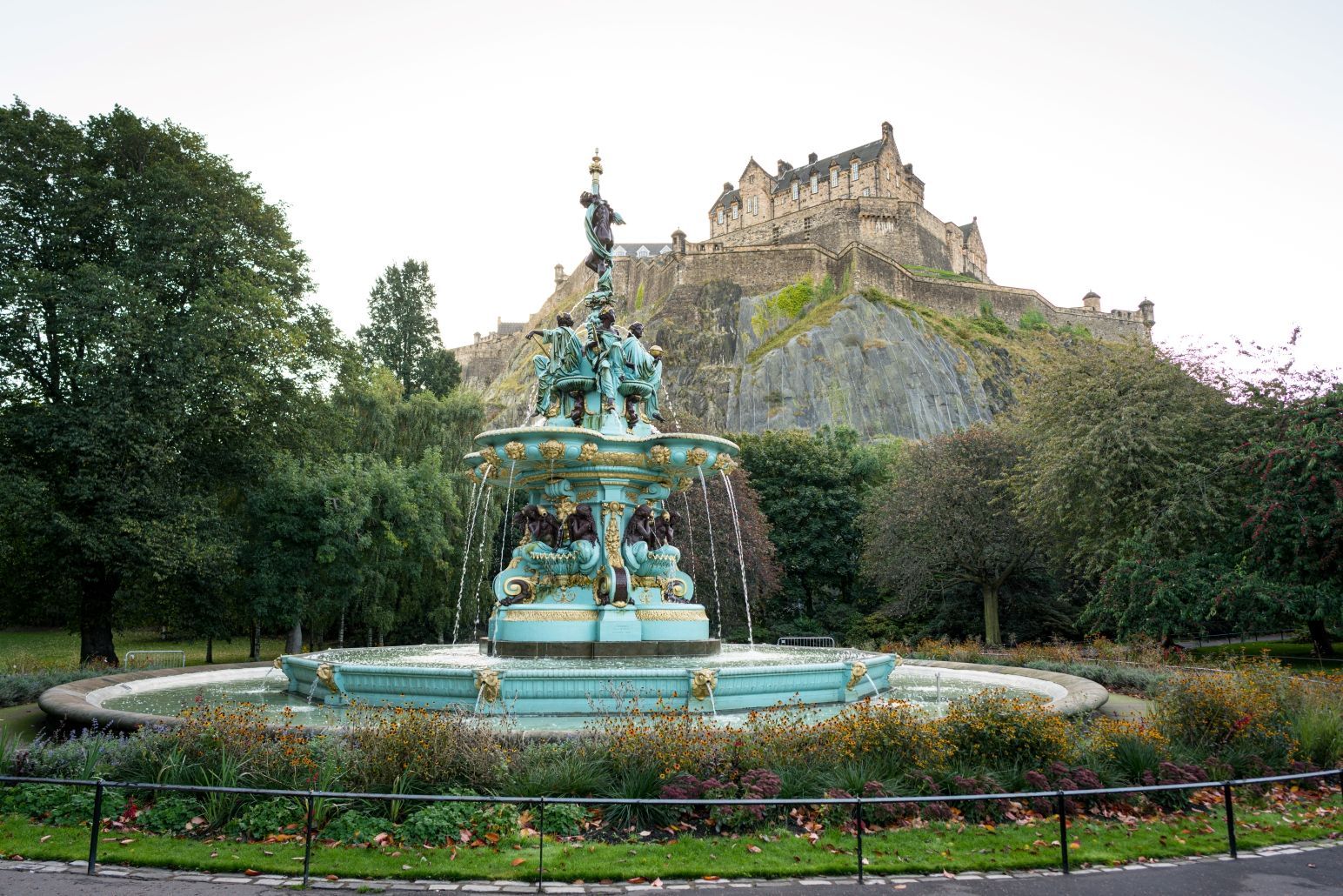
Edinburgh Castle
Castlehill, EH1 2NG

Location of the rediscovery of the Honours of Scotland in 1818, led by Scott.
GPS Coordinates: 55°56'55.0"N 3°11'59.6"W
Scott Connection:
Led the 1818 commission that rediscovered the Honours of Scotland (the Crown Jewels), restoring a central symbol of Scottish nationhood.
Date Range Relevant to Scott: 1818 (rediscovery of the Honours); lifelong symbolic presence in Scott’s Edinburgh.
Current Status:
Historic Environment Scotland heritage site; major national visitor attraction.
Accessibility:
Significant gradients and cobbled surfaces; partial step-free access; consult official accessibility guidance before visiting.
Opening Times:
Seasonal hours; check official Historic Environment Scotland website.

Why This Place Matters
Edinburgh Castle is the most powerful topographic emblem in Scotland — and Scott was directly involved in restoring one of its most potent symbols.
In 1818, Scott played a central role in securing permission for a royal commission to search for the long-lost Honours of Scotland — the Crown, Sceptre, and Sword of State. The regalia had been sealed in a chest in the Crown Room following the 1707 Union and effectively forgotten.
On 4 February 1818, the chest was opened in Scott’s presence. The Honours were found intact.
This was not antiquarian curiosity. It was an act of national historical recovery. Scott helped reinsert Scotland’s ceremonial sovereignty into public consciousness.
Historical Context
After the Union of 1707, the Honours of Scotland fell into obscurity. By the early nineteenth century, uncertainty surrounded their condition and even their survival.
Scott, already widely recognised as a literary interpreter of Scotland’s past, petitioned the Prince Regent for permission to investigate. The subsequent commission included Scott among its key members.
The rediscovery occurred during a period of renewed interest in Scottish history and identity — a climate to which Scott himself had substantially contributed.
The event strengthened the symbolic continuity between medieval Scotland and modern Britain.
Scott Here
Scott was present at the opening of the Crown Room in 1818 and later wrote accounts of the discovery.
The episode informed:
• His historical essays
• Notes and introductions in the Magnum Opus editions of the Waverley Novels
• The broader national-historical framing of works such asThe Fortunes of Nigel
Scott did not simply imagine Scotland’s past — he actively curated it.
The rediscovery also reinforced his role as a mediator between monarchy and nation. Just four years later, he would orchestrate King George IV’s ceremonial visit to Edinburgh in 1822, embedding Highland symbolism into royal pageantry.
The Bigger Theme:
Curated Nationhood
Scott’s significance extends beyond fiction.
At Edinburgh Castle, he acted as historical intermediary — translating archival memory into public ceremony.
The rediscovery of the Honours was theatrical, symbolic, and politically astute. It demonstrated how material artefacts could reactivate national imagination.
Scott’s historical novels dramatise Scotland’s past; his work at the Castle materially reinstated it.
Literary Connections
• The Fortunes of Nigel — concerns royal authority and the political complexities of monarchy.
• Scott’s account of the Honours in
The Regalia of Scotlandshows him acting as historian and public interpreter of national symbols, not merely as novelist.
• Magnum Opus introductions — historical framing and documentary commentary.
• Historical essays reflecting on Scotland’s constitutional past.
The Castle itself appears in multiple narrative contexts as a symbol of power, confinement, and sovereignty.
What to Notice On Site
• The dominance of the Castle Rock over the city.
• The Crown Room (where the Honours were rediscovered).
• The visual relationship between Castle and Royal Mile.
• The alignment of Castle Rock with the axis of Castle Street below.
From the esplanade, look down toward the New Town. The medieval fortress commands the Georgian grid.
Questions to Consider
- Was the rediscovery an antiquarian act — or a political one?
- How did Scott balance loyalty to Britain with recovery of Scottish sovereignty symbols?
- Does the Castle function as history — or as theatre?
Further Reading
Sir Walter Scott, The Regalia of Scotland (arranged in chapters with notes and index by John Sinclair; Edinburgh: published at the Crown Room).
J. G. Lockhart,
Memoirs of the Life of Sir Walter Scott
David Hewitt (ed.),Scott on Himself
Historic Environment Scotland — Official Castle History
Studies of the 1818 Commission and the Honours of Scotland
Official Website

Image credits: Lee Live: Photographer