
Walking Tour: Stop 19
National Monument
Calton Hill, EH7 5AA

Napoleonic War memorial promoted by Edinburgh’s civic leaders during Scott’s lifetime.
GPS Coordinates: 55°57'19.4"N 3°10'55.2"W
Scott Connection:
Public supporter of the campaign to establish a national memorial to Scottish soldiers of the Napoleonic Wars.
Date Range Relevant to Scott: c.1816–1829
Current Status:
Unfinished neoclassical monument on Calton Hill; open public site within Edinburgh’s historic landscape.
Accessibility:
Accessible via footpaths from Regent Road and Waterloo Place; steep approach in places.
Why This Place Matters
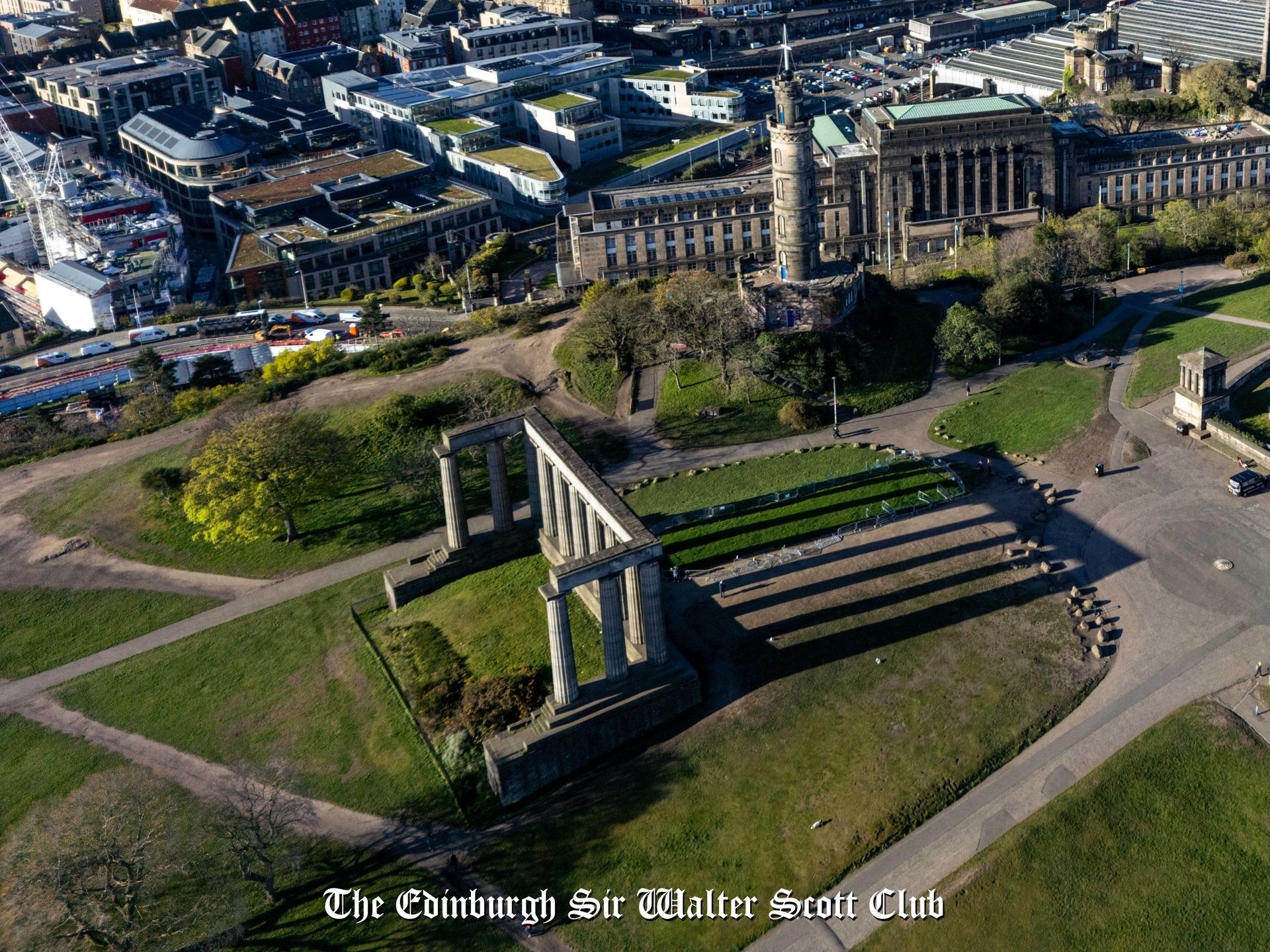
The National Monument on Calton Hill was conceived as a national memorial to the Scottish soldiers and sailors who died during the Napoleonic Wars (1803–1815). Designed as a monumental replica of the Parthenon in Athens, the project formed part of a wider civic effort to position Edinburgh architecturally and culturally as the “Athens of the North.” Construction began in 1826 but halted in 1829 when the fundraising campaign failed to secure the required funds, leaving the structure incomplete. Today the surviving twelve columns represent one of the most recognisable elements of Edinburgh’s skyline and an enduring reminder of the ambitious civic aspirations of early nineteenth-century Scotland.
Historical Context
The idea of a Scottish national memorial to those who had fallen in the Napoleonic Wars emerged in the years following the end of the conflict in 1815. Public subscription campaigns sought to commemorate the sacrifices of Scottish regiments while simultaneously expressing national pride within the framework of the United Kingdom.
The project was entrusted to the architects Charles Robert Cockerell and William Henry Playfair, whose design reproduced the classical form of the Parthenon in Athens. This architectural choice reflected the strong influence of classical revival architecture in early nineteenth-century Edinburgh, particularly in the expanding New Town. Calton Hill, already emerging as a ceremonial landscape of monuments and institutions, was selected as the site for the memorial.
The foundation stone was ceremonially laid on 27 August 1822 during the visit of King George IV to Scotland. The event formed part of a large civic procession that began at Parliament Square and concluded on Calton Hill, symbolising both national commemoration and the city’s architectural ambitions.
Despite the symbolic importance of the project, the estimated cost of approximately £42,000 proved unattainable through voluntary subscription. When construction began in 1826 only a portion of the necessary funds had been secured, and the work ceased in 1829 with only a fragment of the intended structure completed.
Scott Here
Sir Walter Scott was among the prominent Edinburgh figures who supported the campaign to establish the monument. His involvement formed part of a broader pattern of civic engagement in which Scott actively promoted projects intended to shape Edinburgh’s cultural identity and commemorate national history.
Scott’s support for the National Monument is consistent with his wider interest in public memorialisation and historical commemoration. During the same period he played a central role in organising the ceremonial visit of George IV to Edinburgh in 1822, an event that deliberately drew upon historical symbolism and public spectacle to reinforce Scotland’s place within the British state.
Although Scott did not live to see the project completed—or abandoned—the monument stands as a product of the same cultural climate in which he operated: a period characterised by strong interest in national history, antiquarianism, and monumental architecture.
The Bigger Theme
The National Monument illustrates how early nineteenth-century Edinburgh sought to express national identity through architecture and public memorials. The classical style chosen for the monument reflected the intellectual legacy of the Scottish Enlightenment, whose scholars had frequently drawn parallels between Edinburgh and classical Athens.
By replicating the form of the Parthenon, the monument symbolically aligned Scotland with the ideals of classical civilisation—learning, civic virtue, and military sacrifice. The project therefore represents both a memorial to the dead and a statement about Edinburgh’s cultural ambitions during the period in which Scott lived and worked.
Literary Connections
While the monument itself does not feature directly in Scott’s fiction, its intellectual context parallels themes present throughout his historical writing. Scott frequently explored the relationship between national memory and public commemoration, particularly in works concerned with the legacy of war and political transformation.
The monument’s intention—to preserve the memory of a recent national conflict—reflects the same historical consciousness that informs Scott’s novels and narrative poems.
What to Notice On Site
Visitors approaching the monument encounter twelve massive Doric columns forming part of the incomplete west end of the intended Parthenon-style structure. The scale of the columns and the exposed platform illustrate the ambition of the original design, which would have replicated the dimensions of the ancient Greek temple.
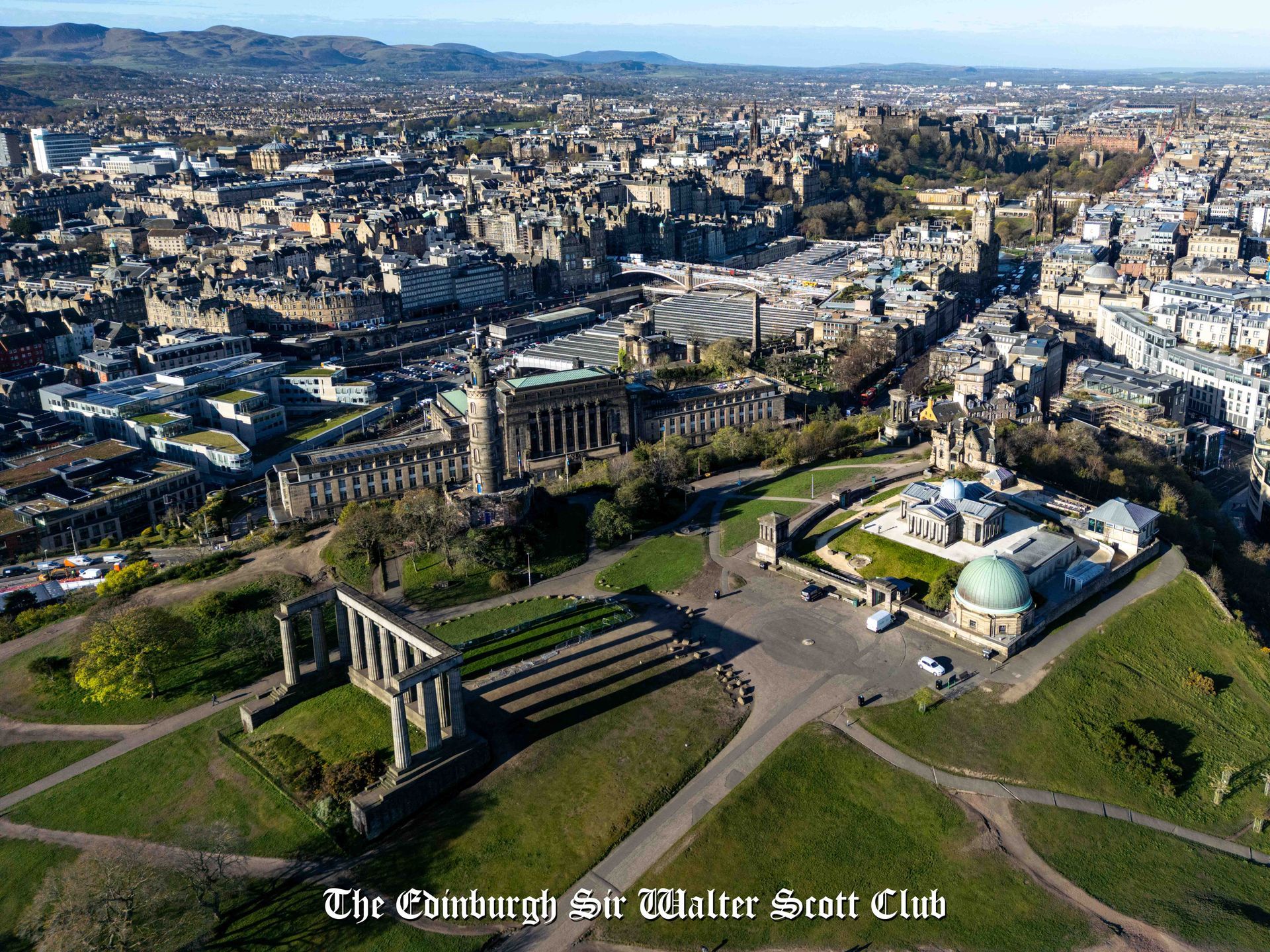
The monument’s elevated position on Calton Hill provides extensive views across both the Old Town and New Town of Edinburgh. From this vantage point the structure participates in a broader monumental landscape that includes the Nelson Monument, the Dugald Stewart Monument, and the former Royal High School, all products of the same period of civic architectural development.
Questions to Consider
Why did early nineteenth-century Edinburgh choose classical Greek architecture to commemorate modern military sacrifice?
What does the unfinished state of the monument reveal about the limits of voluntary civic fundraising in this period?
How does the monument contribute to the idea of Edinburgh as the “Athens of the North”?
Further Reading
Youngson, A. J. -
The Making of Classical Edinburgh.
Withers, Charles. - The Oxford Companion to Scottish History.
McKee, Kirsten Carter. -“The Genius Loci of the Athens of the North: The Cultural Significance of Calton Hill.”
Official Website
Historic Environment Scotland – National Monument of Scotland
Did You Know
The National Monument was originally intended to replicate the Parthenon in Athens in full scale. Financial difficulties halted construction in 1829 after only twelve columns had been completed, giving the structure its long-standing nickname “Edinburgh’s Disgrace". It is also known as "The Shame of Edinburgh" or "Scotland's Folly".