

Walking Tour: Stop N
Paul’s Work
North Back Canongate, EH8 8DQ

Site of James Ballantyne’s printing works where Scott’s early novels were physically produced.
GPS Coordinates: 55°57'09.7"N 3°11'07.3"W
Scott Connection:
Site of the printing works operated by James Ballantyne, where many of Scott’s works—including the early Waverley novels—were set in type and printed.
Date Range Relevant to Scott: 1805–1826
Current Status:
The original printing premises no longer survive. The buildings of Paul’s Work were most likely demolished in the mid-nineteenth century during the construction of
Waverley Station
and its associated railway yards.
Accessibility:
The approximate location lies within the area behind the Canongate now occupied by railway infrastructure.
(Exterior viewing only.)
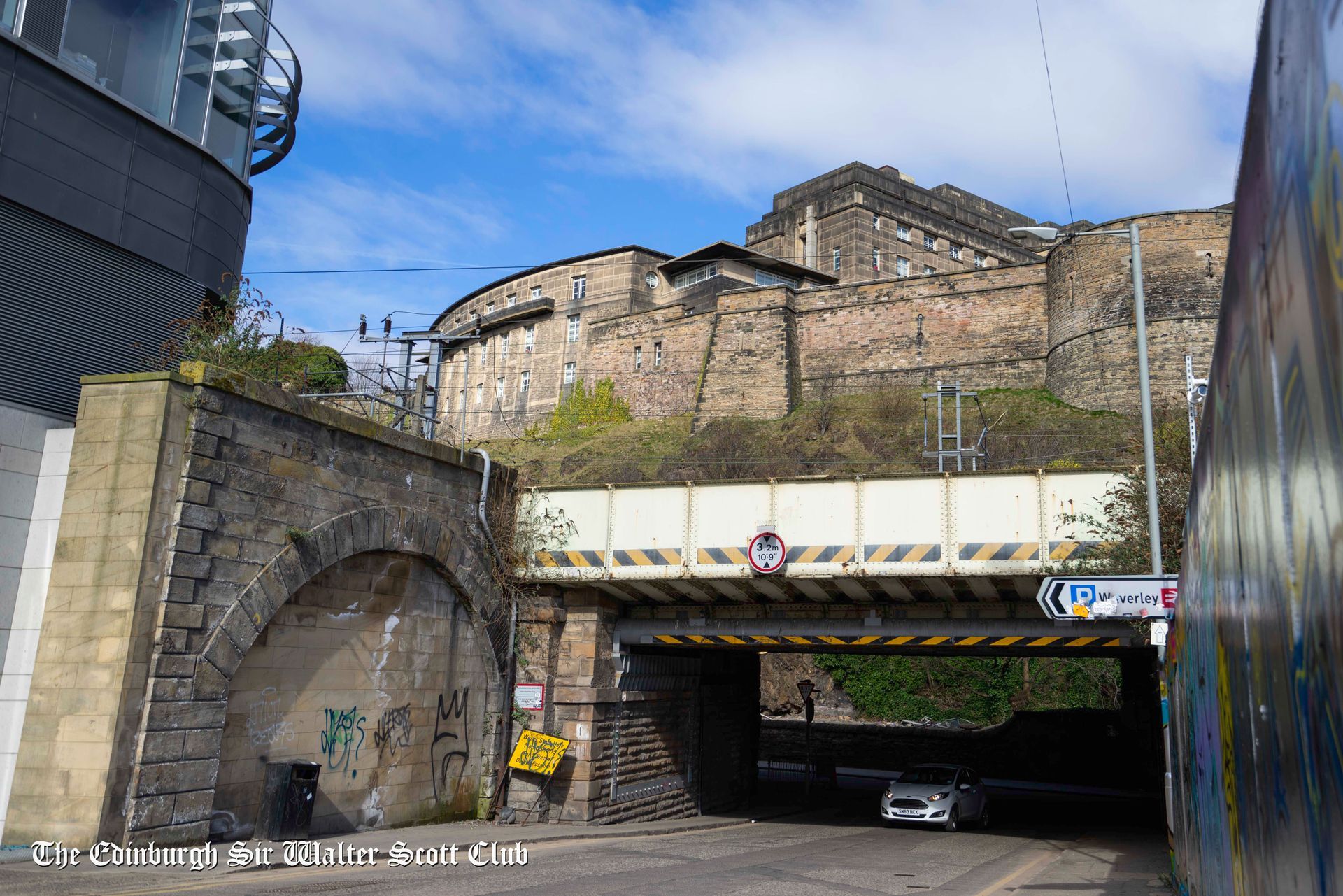
New Street
Why This Place Matters
Paul’s Work was the location of the printing establishment run by James Ballantyne, Sir Walter Scott’s printer, editor, and business partner. Here Scott’s manuscripts were transformed into printed books through the labour of compositors, proofreaders, and pressmen.
While Scott wrote his novels at locations such as 39 Castle Street and later Abbotsford, the physical production of the books occurred in places like Paul’s Work. The site therefore represents the mechanical stage of literary creation—the moment when manuscripts passed from the author’s desk into the industrial processes of the printing trade.
In this sense Paul’s Work formed the operational centre of Scott’s literary production.
Historical Context
In the early nineteenth century the Edinburgh book trade was concentrated within a remarkably small area of the city. Booksellers, printers, publishers, and authors operated within a compact network of streets and closes around the High Street and Parliament House.
Archibald Constable’s bookshop, Robert Cadell’s premises, Ballantyne’s printing works, and Scott’s own residence were all located within relatively short walking distance of one another. This proximity allowed manuscripts, proofs, and printed sheets to circulate rapidly between the different participants in the publishing process.
Paul’s Work on the North Back Canongate formed part of this network. It housed Ballantyne’s printing presses at the point where literary manuscripts were converted into printed pages ready for publication.
Buildings in this area were often identified by traditional names rather than modern street numbers, which explains why contemporary references simply describe the location as “Paul’s Work, North Back Canongate.”
The press at Paul’s Work continued to operate after Scott’s death and was responsible for printing volumes of the so-called Magnum Opus edition, the collected edition of Scott’s novels issued from 1829 onward.
Scott Here
Scott’s relationship with Ballantyne involved constant exchange between author and printer. Manuscripts written in the New Town travelled to the Old Town printing works, where compositors set the text in movable type. Proof sheets were then returned to Scott for correction before the pages were finally printed.
Ballantyne was not merely a tradesman. As printer and proof-reader he became one of the first readers of Scott’s work, offering comments and suggestions during the printing process.
The collaboration therefore linked Scott’s imaginative writing directly with the practical mechanics of the printing trade.
The Bigger Theme
Paul’s Work demonstrates that the success of the Waverley novels depended upon more than individual literary genius. Their publication required a coordinated system linking authors, printers, publishers, and booksellers within the city.
The Waverley phenomenon was therefore both literary and industrial. Scott supplied the manuscripts, but the presses of Ballantyne’s printing house made possible the large-scale production that carried his novels across Britain and beyond.
Literary Connections
Beginning with Waverley in 1814, Scott produced a series of historical novels that rapidly achieved international popularity. The books were printed under Ballantyne’s supervision and issued through the publishing house of Archibald Constable, forming one of the most successful literary enterprises of the nineteenth century.
The printing operations at Paul’s Work were therefore integral to the emergence of Scott’s reputation as the leading historical novelist of his age.
What to Notice On Site
Although the original printing buildings no longer survive, the surrounding Old Town streets preserve the dense pattern of closes and backlands characteristic of Edinburgh’s historic urban fabric.
This compact geography helps explain how the various elements of the book trade—authors, printers, and publishers—operated within a tightly connected network of streets.
Questions to Consider
How did the physical infrastructure of the printing trade shape the production of nineteenth-century literature?
What role did printers such as James Ballantyne play in the success of Scott’s novels?
How did the close proximity of Edinburgh’s book trade participants influence the rapid production of the Waverley novels?
Further Reading
Lockhart, J. G. - Memoirs of the Life of Sir Walter Scott.
Millgate, Jane. - Walter Scott: The Making of the Novelist.
Garside, Peter. - “Edinburgh Locations and the Production of the Waverley Novels.”
Did You Know?
A hand printing press associated with James Ballantyne’s printing house at Paul’s Work survives today and has been exhibited in Edinburgh as part of displays on the production of the Waverley
novels.