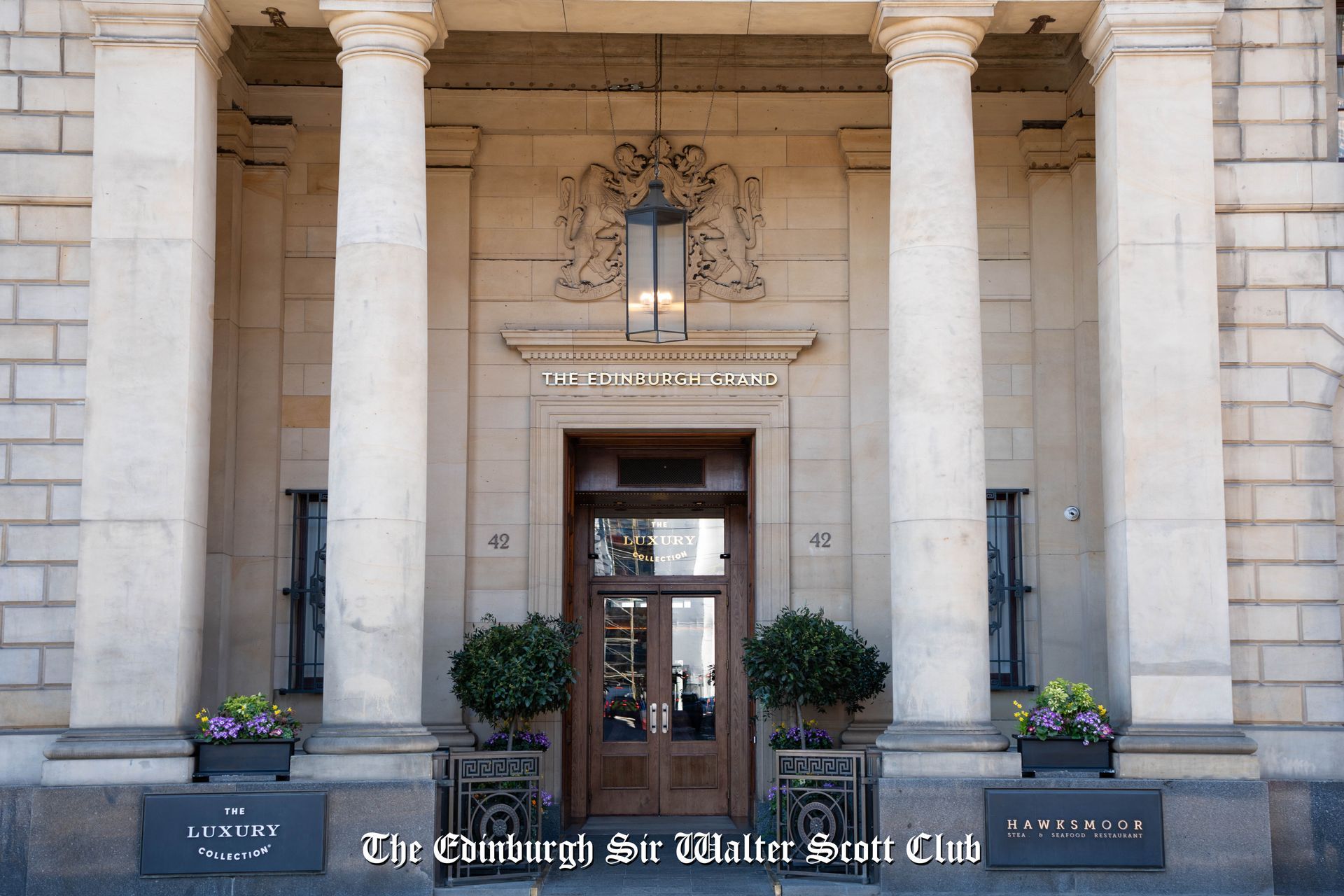

Walking Tour: Stop D
Robert Cadell’s Shop
41, St Andrew Square, EH2 2AD

Premises of Robert Cadell, Sir Walter Scott’s principal publisher after the financial crash of 1826.
GPS Coordinates: 55°57'13.6"N 3°11'32.0"W
Scott Connection:
Robert Cadell became Sir Walter Scott’s principal publisher following the collapse of Archibald Constable & Co. in 1826.
Date Range Relevant to Scott: c.1826–1832
Current Status:
The original premises associated with Cadell’s bookselling and publishing business no longer survive in their early nineteenth-century form; the site lies within the commercial district surrounding St Andrew Square.
Accessibility:
The historic site of Cadell’s shop is now occupied by The Edinburgh Grand at 41–42 St Andrew Square. The exterior of the building can be viewed from the square.

Why This Place Matters
The publishing house of Robert Cadell became central to the final phase of Sir Walter Scott’s literary career. After the dramatic financial collapse of Archibald Constable & Co. in January 1826, Scott found himself personally liable for debts amounting to more than £100,000. Rather than declaring bankruptcy, he resolved to repay the debt through continued literary production.
Cadell’s firm assumed responsibility for publishing Scott’s subsequent works and managing the complex financial arrangements required to address the outstanding liabilities. The partnership therefore represents one of the most remarkable episodes of professional resilience in nineteenth-century literary history.
Historical Context
Robert Cadell (1788–1849) had been a partner in the publishing firm of Archibald Constable, which had played a decisive role in the success of Scott’s earlier works. When Constable’s business collapsed in 1826, Cadell reorganised the publishing operation under his own name and continued to work with Scott to manage the aftermath of the financial crisis.
The crash had been triggered by a chain of failures within the Edinburgh and London publishing trade, including the bankruptcy of the London firm Hurst, Robinson & Co. The collapse reverberated throughout the British book trade, bringing down several interconnected publishing houses.
Cadell’s subsequent role involved both publishing Scott’s new works and supervising the financial management of Scott’s literary estate in order to repay the debts owed to creditors.
Scott Here
Following the events of 1826, Scott entered into a working partnership with Robert Cadell that would continue until the end of his life. Through Cadell’s firm Scott published a number of major works written during this final phase of his career.
Among these were later novels such as Woodstock (1826) and Anne of Geierstein (1829), as well as the monumental Life of Napoleon Bonaparte (1827), one of Scott’s most ambitious historical works.
Cadell also played a crucial role in managing the publication of Scott’s collected editions and overseeing the financial arrangements that gradually reduced the debt incurred during the collapse of Constable’s business.
The Bigger Theme
Robert Cadell’s shop represents the publishing partnership that enabled Scott’s financial recovery. The relationship illustrates the extent to which nineteenth-century authorship depended upon complex networks of publishers, printers, and financial intermediaries.
Scott’s determination to repay his debts through literary labour became one of the defining episodes of his later life. The sustained output of historical novels, biographies, and essays during the late 1820s and early 1830s reflects both personal resolve and the professional structures that made continued publication possible.
Literary Connections
The works produced during Scott’s final publishing partnership with Cadell reveal a writer working under intense financial pressure yet maintaining remarkable productivity.
Scott’s late novels and historical writings continued to explore themes of political change, historical memory, and national identity, demonstrating that the financial crisis of 1826 did not diminish his intellectual ambition.
What to Notice On Site
St Andrew Square formed one of the principal commercial centres of Edinburgh’s New Town during the early nineteenth century. The location of publishing businesses in this district reflects the shift of Edinburgh’s professional and commercial life from the Old Town into the expanding New Town.
The square itself was surrounded by banks, professional offices, and commercial premises, illustrating the financial and institutional networks that supported the city’s publishing industry.
Questions to Consider
How did Scott’s determination to repay his debts shape the final phase of his literary career?
What role did publishers such as Robert Cadell play in sustaining the literary marketplace of early nineteenth-century Britain?
How did the financial structures of the publishing industry affect the lives of authors?
Further Reading
Millgate, Jane. -
Walter Scott: The Making of the Novelist.
Sutherland, John - The Victorian Novelists and Publishers.
Did You Know?
After Scott’s death, his publisher Robert Cadell purchased the seated statue of Scott sculpted by John Greenshields in 1835. For many years the figure stood at the entrance to Cadell’s shop in St Andrew Square, greeting visitors to the publishing house that managed Scott’s literary estate.