

Walking Tour: Stop I
Rose Court
Thistle Court, off Thistle Street, EH2 1DD

Location near which Scott considered taking chambers during the financial crisis of 1826.
GPS Coordinates: 55°57'16.0"N 3°11'45.2"W
Scott Connection:
Area associated with the residence of William Clerk of Eldin, a close friend of Sir Walter Scott. In February 1826, following the collapse of his publishers, Scott recorded that he considered taking chambers near Clerk.
Date Range Relevant to Scott: 1826
Current Status:
Rear elevations of commercial premises on George Street overlooking the garden plots behind Castle Street houses.
Accessibility:
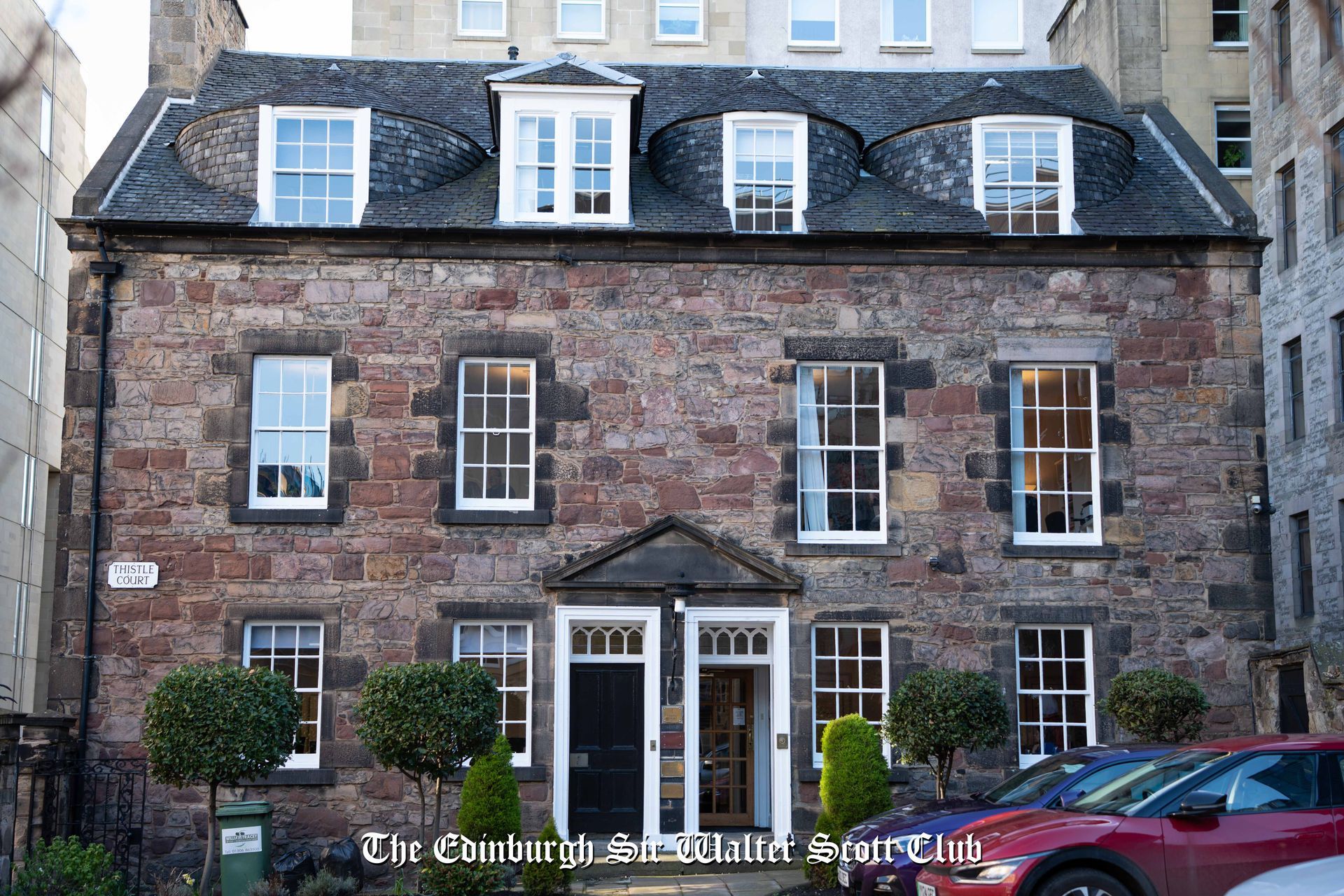
Thistle Court, a narrow lane between George Street and Thistle Street in Edinburgh’s New Town, now occupied by later commercial and office premises. (Exterior viewing only.)
Why This Place Matters
Rose Court, now known as Thistle Court, represents a moment of profound uncertainty in Sir Walter Scott’s life. In January 1826, the collapse of the publishing house of Archibald Constable & Co. triggered a financial crisis that left Scott liable for debts exceeding £100,000. The bankruptcy also involved the printing firm of James Ballantyne, Scott’s long-time collaborator.
Within weeks Scott was forced to reconsider his living arrangements. Having been abruptly dispossessed of his residence at 39 Castle Street, he briefly contemplated taking more modest lodgings in the vicinity of Rose Court near the house of his friend William Clerk of Eldin.
The episode reveals the immediate impact of the financial collapse upon Scott’s personal circumstances before he resolved to repay his debts through continued literary labour.
Historical Context
Rose Court, now known as Thistle Court, lies just off the east end of Thistle Street behind St Andrew’s Church in George Street. It consisted of two pairs of semi-detached houses facing each other within a small court. The buildings are reputed to include some of the earliest houses constructed in the New Town.
It formed part of the original street pattern of Edinburgh’s New Town, planned in the late eighteenth century by the architect James Craig. The narrow courts and lanes connecting the principal streets provided access to service areas and secondary residences behind the grand terraces of George Street and Princes Street.
Some contemporary accounts suggest that Rose Court contained among the earliest houses constructed during the initial phase of New Town development. The area lay within easy reach of the homes of lawyers, merchants, and members of Edinburgh’s professional classes.
William Clerk of Eldin, advocate and close friend of Scott, resided nearby. Clerk belonged to the same social and professional networks that connected Scott with the legal and intellectual life of the city.
Scott Here
On 25 February 1826, Scott recorded in his Journal the upheaval caused by the collapse of his publishing partners. The sudden loss of financial stability forced him to consider practical alternatives for his accommodation.
Among the possibilities he noted was the idea of taking chambers near William Clerk. The remark suggests a temporary retreat from the more expansive domestic life Scott had enjoyed at Castle Street.
Although Scott ultimately did not move to Rose Court, the entry captures the uncertainty of the moment before he determined to meet his debts through continued writing.
The Bigger Theme
Rose Court illustrates the contrast between Scott’s earlier prosperity and the financial crisis that transformed his circumstances in 1826. The elegant townhouses of the New Town represented the social ambitions of Edinburgh’s professional elite.
For Scott to contemplate relocating to modest chambers within this orderly urban grid underscores the abrupt change brought about by the collapse of Constable’s publishing house.
The episode therefore marks a turning point between Scott’s established literary success and the strenuous period of writing that followed as he worked to repay his creditors.
Literary Connections
The financial crisis of 1826 led directly to the remarkable sequence of works Scott produced during the final years of his life. Determined to repay his debts in full, he embarked upon an intense period of literary labour.
Among the works written in the years following the crisis were the novel Woodstock (1826) and the extensive historical biography The Life of Napoleon Bonaparte (1827).
The brief consideration of chambers near Rose Court therefore belongs to the opening phase of the episode that reshaped Scott’s later career.
What to Notice On Site
Thistle Court today retains the narrow proportions typical of New Town service lanes connecting the larger streets. The court runs between George Street and Thistle Street, providing a glimpse of the secondary urban spaces that supported the grand terraces of the eighteenth-century plan.
Although the original houses associated with Rose Court have largely disappeared, the passage itself still conveys the intimate scale of these early New Town courts.
Questions to Consider
How did the financial structures of the nineteenth-century publishing trade affect the lives of authors?
What does Scott’s contemplation of moving to chambers reveal about the immediacy of the crisis in 1826?
How does the orderly geometry of Edinburgh’s New Town contrast with the personal upheaval Scott experienced during this period?
Further Reading
Scott, Walter -
The Journal of Sir Walter Scott.
Millgate, Jane -Walter Scott: The Making of the Novelist.
A. J. Youngson. - The Making of Classical Edinburgh
Did You Know?
Despite the scale of the debts created by the publishing collapse of 1826, Scott refused to declare bankruptcy. Instead he resolved to repay the creditors through his writing—a commitment that shaped the final years of his life.