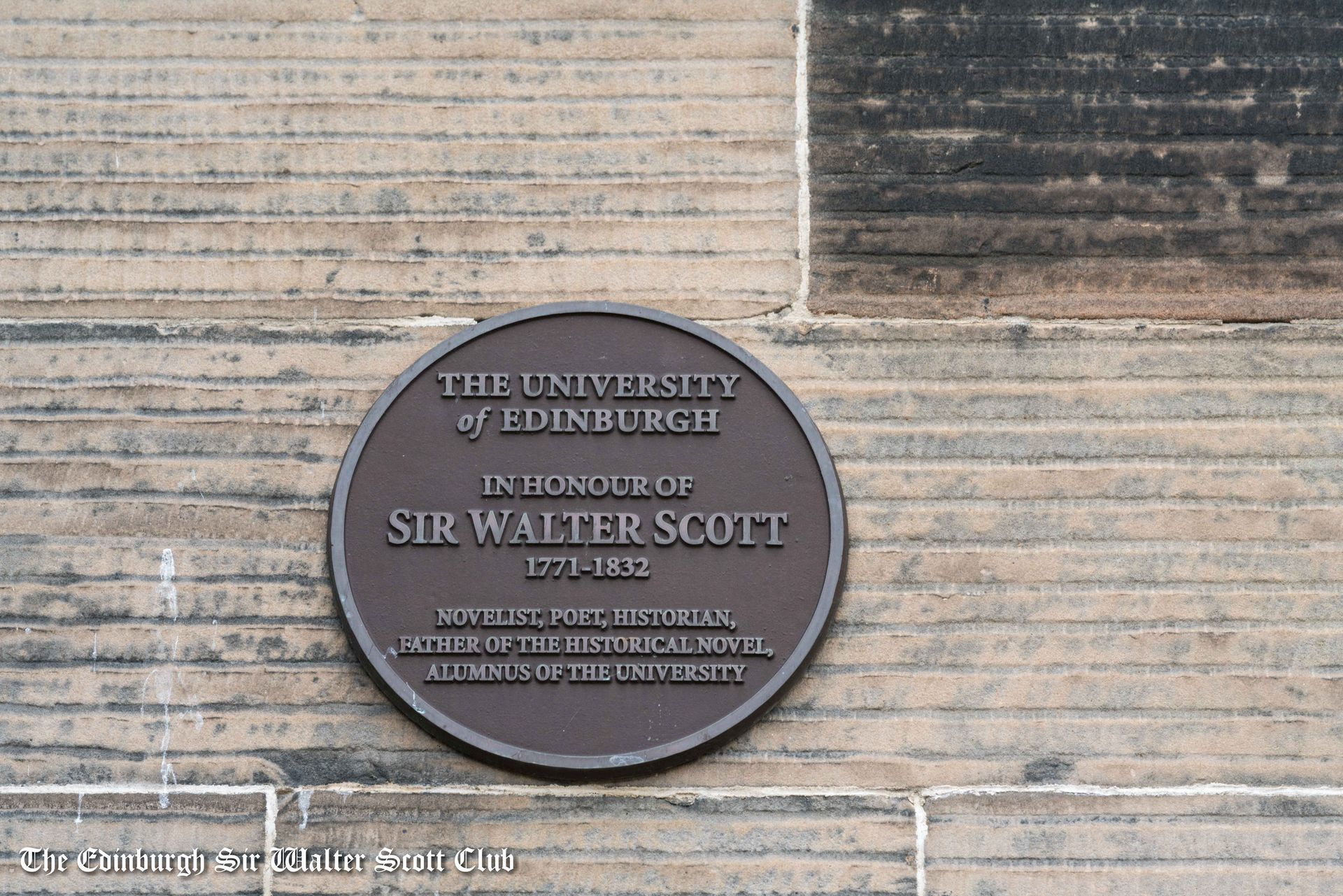

High School Yards

Where the Archive Instinct and the Storyteller Emerged
Address
High School Yards: Edinburgh:
Postcode: EH1 1LZ
GPS Coordinates:
55.94793, -3.18489
Scott Connection
Early education at the Royal High School; formative intellectual and storytelling development.
Date Range Relevant to Scott: c. 1779–1783
Current Status
University of Edinburgh buildings; historic educational site; exterior viewing.
Accessibility
Street-level access; moderate Old Town gradients; uneven historic paving in surrounding area.
Why This Place Matters
High School Yards marks the beginning of Scott’s intellectual formation. Long before he became a novelist, advocate, or national figure, he was a schoolboy absorbing languages, history, and rhetoric within the disciplined framework of Enlightenment education.
But this was not merely a site of instruction. It was where the habits that underpinned his later career began to take shape: collection, narration, and the transformation of historical material into compelling story. Scott’s imagination was nourished not only by books, but by the city’s murders, legends, relics, and lived memory.
This stop anchors the formation phase of the tour. Without it, the later Scott — the advocate, the historian-novelist, the president of learned societies — risks appearing fully formed. High School Yards reminds us that method precedes myth, and that storytelling begins in place.
Historical Context
Late eighteenth-century Edinburgh was a centre of Enlightenment education. Schools emphasised classical languages, rhetoric, disciplined argument, and historical awareness. The Royal High School trained boys for professional life, particularly in the law.
The surrounding district formed part of a dense Old Town intellectual quarter, close to the university and within walking distance of Parliament House. Urban density and scholarly ambition coexisted. This was a city where legal training, antiquarian curiosity, and civic responsibility were intertwined.
The ground itself carried dramatic associations. The garden once occupying this site was linked to the murder of Henry, Lord Darnley, husband of Mary, Queen of Scots. Such stories, rooted in real streets and buildings, formed part of the city’s imaginative inheritance.
Scott Here
Scott attended the Royal High School following periods of childhood illness that left him physically fragile but intellectually alert. During his school years he developed facility with Latin, absorbed historical narrative, and gained a reputation among his peers as a gifted storyteller.
He later recalled how, during “the winter play hours, when hard exercise was impossible,” his tales gathered an admiring audience around “Lucky Brown’s fireside,” and “happy was he that could sit next to the inexhaustible narrator.” Scott himself admitted that his youthful enthusiasm lay in “the wonderful and the terrible — the common taste of children.”
Edinburgh’s darker tales would have been irresistible: the murder of Darnley, the scandals of the Old Town, and figures such as Deacon Brodie, the cabinet-maker turned burglar, whose execution occurred during Scott’s youth.
At the same time, Scott began collecting what he later called the “touch-pieces” of his fiction — treasured objects connected to Scottish history. In his father’s house in George Square he assembled coins, weapons, relics, and books: material fragments that foreshadow the antiquarian richness of the Waverley novels.
Through storytelling, study, and long walks within the bounds his father permitted — “away and back within the same day” — Scott’s imaginative geography was shaped by what the city itself could offer.
The Bigger Theme
The Archive Instinct and the Urban Story
High School Yards represents the origin of Scott’s archive instinct and narrative method.
Before he invented historical fiction, he gathered materials. He listened, copied, recorded, and collected. His legal education and school discipline reinforced habits of documentation and structured argument. But alongside that method grew a delight in the dramatic and the terrible.
Scott’s fiction often presents itself as edited manuscript, recovered narrative, or mediated history. That framing device reflects an early training in textual authority combined with a boyhood fascination with urban legend and scandal.
This is where disciplined Enlightenment method and Romantic storytelling first met.
Literary Connections
Minstrelsy of the Scottish Border (1802–03) — reflects early habits of collection and preservation.
Waverley (1814) — structured as mediated historical narrative rather than pure romance.
Old Mortality (1816) — foregrounds inscription, memory, and the preservation of the past.
The Heart of Midlothian (1818) — demonstrates how urban crime, law, and moral drama become narrative architecture.
What to Notice On Site
Observe:
- The density of the Old Town street pattern
- The proximity to university buildings
- The sense of layered masonry and accumulated use
- The modest scale compared to later New Town expansiveness
This is a compressed intellectual environment. The narrow streets contrast sharply with the rational geometry encountered later at Castle Street.
Questions to Consider
- Was Scott first an archivist who learned to tell stories — or a storyteller who learned to organise history?
- How did Edinburgh’s crimes and legends shape his sense of drama?
- Would the historical novel have taken the same form without this early mixture of discipline and narrative play?
Further Reading
J.G. Lockhart,
Memoirs of the Life of Sir Walter Scott
Andrew Lang,Sir Walter Scott
David Hewitt (ed.), Edinburgh University Press Waverley Novels
Dr Lucy Wood, “Scenes from the Waverley Novels”