
Walking Tour: Stop W
The Shore
Leith, EH6 6QN

The landing place of George IV in Scotland, 15th August 1822, and a defining moment in Sir Walter Scott’s orchestration of Scotland’s royal pageantry.
GPS Coordinates: 55°58'35.9"N 3°10'19.7"W
Scott Connection:
Scott played a leading role in organising George IV’s 1822 visit to Scotland, helping to choose Leith as the landing place and shaping the ceremonies that followed.
Date Range Relevant to Scott: 1822 - The Royal Visit
Current Status:
The Shore remains a public waterfront in historic Leith. Commemorative plaques mark the landing of George IV on 15th August 1822. The harbour and its surroundings have changed, but the location retains a direct association with the royal visit.
Accessibility:
The Shore is a public area accessible from surrounding streets. The precise approach to the plaques should be checked on site. One of the commemorative inscriptions is on the water side of the harbour wall and has been described as difficult to access. Waterfront surfaces and access arrangements may vary.

Why This Place Matters
On 15th August 1822, George IV came ashore at Leith during his visit to Scotland. It was the first visit to Scotland by a reigning monarch for more than 170 years, and it opened a programme of public ceremonies that would become one of the most influential displays of Scottish historical identity in the nineteenth century.
Sir Walter Scott was central to the organisation of the visit. He helped shape its ceremonial character, drawing upon Scottish history, royal associations, costume and public spectacle. The landing at Leith was therefore more than a logistical event: it was the opening scene of a carefully constructed presentation of Scotland to its monarch and to the wider public.
The choice of Leith was significant. Scott favoured it over the more practical deep-water harbour at Newhaven because of its historical associations, particularly the landing of Mary, Queen of Scots, in 1561. The shallower water required the King and his party to transfer from the royal yacht to smaller boats before reaching the shore.
The commemorative plaques preserve the memory of the event at the place where it happened. Together with contemporary paintings, engravings and written accounts, they provide a starting point for exploring how Scott helped turn a royal visit into a public expression of Scottish history and identity.
Historical Context
George IV’s visit took place in August 1822, following his accession to the throne in 1820. The visit was politically significant. The King was unpopular with many Scots, not least because of his treatment of his estranged wife, Caroline of Brunswick. The Government and royal household had reason to hope that a carefully organised visit might strengthen the monarchy’s standing in Scotland.
Scott was approached because of his literary reputation, public standing and knowledge of Scottish history. He worked with others, including the actor-manager William Henry Murray, to organise a sequence of ceremonies and entertainments that would present the King as a figure connected with Scotland’s distinctive historical traditions.
The royal yacht arrived in the Firth of Forth on 14th August. The landing had been planned for that day, but stormy weather made it unsafe. Scott nevertheless went out by boat to meet the King aboard the royal yacht, Royal George. According to Alasdair Hutton’s account of the visit, George greeted him with the words: “What! Sir Walter Scott, the man in Scotland I most wish to see!”
After a toast in whisky, Scott asked to keep the King’s glass as a memento. He carefully wrapped it and placed it in his pocket. On returning home, however, he sat down and heard the glass break. The story, recounted by Hutton in his account of the Club’s 2022 bicentenary dinner, captures the mixture of personal encounter and practical mishap behind the grand public occasion.
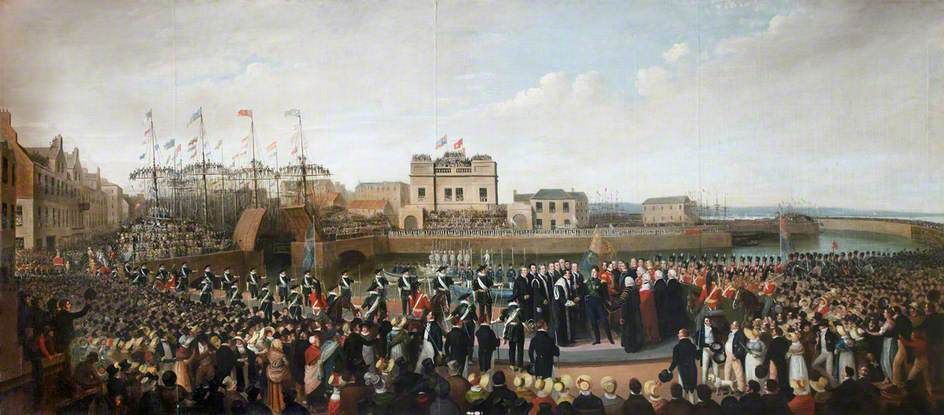
The following day, the weather improved. George IV, wearing naval uniform, came ashore on a red carpet strewn with flowers. More than fifty members of the Royal Company of Archers, the sovereign’s bodyguard in Scotland, were present. Scott had been elected to the Company the previous year.
The royal procession then travelled towards Edinburgh, accompanied by crowds and public displays. The route continued up Leith Walk, where the keys of the city were presented to the King, before the procession proceeded through Edinburgh towards the Palace of Holyroodhouse. The visit continued with ceremonies involving the Scottish regalia, Highland dress, civic bodies, music and dance.
Scott published Hints Addressed to the Inhabitants of Edinburgh and Others in Prospect of His Majesty’s Visit under the pseudonym “An Old Citizen”. Sold for a shilling, the pamphlet offered advice on the arrangements and expected behaviour. Its detailed instructions, including guidance on dress, show that Scott was concerned not only with the broad symbolism of the visit but also with the practical presentation of the city and its inhabitants.
The landing was recorded by several artists. William Home Lizars produced an engraving showing the crowded waterfront; James Skene made a watercolour of the scene; and Alexander Carse created a large oil painting of the landing. These works are important visual records, although each is also a composed representation of the event rather than a neutral photograph-like record.
Scott Here
Scott’s role began before George IV set foot on Scottish soil. When the royal yacht arrived in the Firth of Forth on 14th August, Scott went out in the rain to meet the King. The exchange aboard the yacht became one of the best-known anecdotes of the visit. Hutton’s account records the King’s enthusiastic greeting and Scott’s unsuccessful attempt to preserve the whisky glass as a royal souvenir.
The next day, Scott’s work as an organiser came into public view. The choice of landing place, the guard of honour, the procession and the ceremonies that followed were part of a wider plan to present Scotland through a combination of historical associations and contemporary pageantry.
Scott’s influence extended well beyond the landing itself. He encouraged the use of tartan and Highland dress, promoted the display of Scottish historical symbols and advised the public on the conduct of the celebrations. His work with William Henry Murray helped make the visit a sequence of carefully designed public spectacles, including a Highland ball and theatrical performances.
The visit was not simply a spontaneous outpouring of affection for the King. It was organised to create a particular impression of Scotland and its relationship with the monarchy. Scott’s contribution lay in presenting Scotland’s history and traditions in a form that could unite Highland and Lowland identities within the wider British state.
The landing at Leith is therefore a fitting place to consider Scott as a stage-manager of history: a writer who applied his knowledge of the past and his understanding of public feeling to the organisation of a major national occasion.
The Bigger Theme
Historical Memory, Pageantry and National Identity
George IV’s landing at Leith illustrates how public ceremony can shape a nation’s image of itself. Scott brought historical associations, national symbols, costume and procession together to create a distinctive representation of Scotland for the King and his subjects.
The choice of Leith linked the visit with earlier Scottish history, particularly the arrival of Mary, Queen of Scots, in 1561. The procession into Edinburgh, the display of Highland dress and the use of Scottish regalia extended that historical framing throughout the visit.
Scott did not invent Scotland’s history, but he helped select and arrange its symbols for a particular public purpose. The result was an influential representation of Scottish identity that combined historical distinctiveness with loyalty to the Crown. It also helped popularise the association of tartan and Highland dress with Scotland as a whole.
The visit was a carefully staged spectacle, but its effects extended beyond the ceremonies themselves. It helped shape how Scotland was represented to visitors and to later generations, and it remains an important episode in the history of Scottish national imagery.
The landing can also be considered through its visual record. Alexander Carse’s painting, William Home Lizars’s engraving and James Skene’s watercolour each preserve the event in a different form. They show how the royal arrival became an image as well as a ceremony: something that could be remembered, reproduced and reinterpreted long after the crowds had dispersed.
The bicentenary celebrations in 2022 demonstrated the continuing interest in this episode. The Edinburgh Sir Walter Scott Club and The New Club marked the anniversary with a joint dinner, accompanied by performances of period dance and music by Les Danses Antiques. In its combination of historical reference, music and performance, the commemoration echoed aspects of the original visit.
Literary Connections
Hints Addressed to the Inhabitants of Edinburgh and Others in Prospect of His Majesty’s Visit (1822)
Scott’s anonymously published pamphlet is the most direct literary connection with the landing. Issued under the persona “An Old Citizen”, it gave advice on the arrangements for the King’s visit and the behaviour expected of Edinburgh’s inhabitants. Its practical detail reveals how closely Scott was involved in shaping the occasion.
“Carle, now the King’s come”
Scott wrote this song for the royal visit. Its celebratory character reflects the effort to present the occasion as a shared national event.
The Waverley novels and historical imagination
The landing is not a scene from a Waverley novel, but it illuminates an aspect of Scott’s work as a novelist and historian. In his fiction, historical people, places and events are shaped into narratives that connect the past with the concerns of later generations. In 1822, he applied a comparable sensibility to public ceremony, using historical symbols to give a contemporary event a sense of continuity with Scotland’s past.
Rob Roy on stage
During the royal visit, George IV attended a theatrical performance of Rob Roy, adapted and produced by William Henry Murray. Hutton records that the King particularly enjoyed the humour of Bailie Nicol Jarvie, including the line about “Nane o’ your Lun’on tricks”. The performance provides a further connection between Scott’s literary work, the theatre and the public culture of the royal visit.
What to Notice On Site
The commemorative plaques
Two inscriptions are associated with the landing at The Shore. One bears the Latin phrase O Felicem Diem — “Oh, happy day!” — while another inscription on the water side of the harbour wall records the landing:
“Here our gracious sovereign, George IV first touched Scottish ground on Thursday 15th August 1822.”
The latter inscription also names local civic figures associated with the occasion. Its precise condition and accessibility should be checked during a site visit, as it has been described as difficult to see from the public side of the wall.
Record the exact wording, position and condition of each plaque. Their relationship to the water’s edge helps explain how the landing has been commemorated at the site itself.
The waterfront and the historic harbour
Look at the relationship between The Shore, the Water of Leith and the surrounding buildings. The waterfront has changed considerably since 1822, but the location still allows visitors to imagine the movement of boats, the arrival of the royal party and the formation of the procession.
Historic Environment Scotland identifies the Old Ship Tavern, on the site where The Ship on the Shore stands today, in William Home Lizars’s engraving of the landing. Comparing the engraving with the present-day waterfront can help visitors distinguish surviving historical associations from later development.
Alexander Carse’s painting
Carse’s George IV Landing at Leith, 1822 is a large oil painting, approximately 160.1 × 362 cm, now in the collection of the City Art Centre, Edinburgh. It depicts the King among the assembled dignitaries and spectators, with the harbour buildings behind them.
The Custom House on the opposite bank of the Water of Leith is a particularly useful feature to look for in reproductions of the painting. It provides a point of comparison with the modern setting. Carse’s composition is both a record of the landing and a carefully arranged historical image.
Other contemporary images
James Skene’s watercolour, The Landing of King George IV at Leith, August 15th 1822, shows crowds lining the quayside and watching the flotilla of smaller boats. The raised bridge, the Custom House and other buildings help establish the historic harbour setting.
William Home Lizars’s engraving is another important source. Its detail includes the crowded waterfront and buildings whose signs can be identified, allowing historians to reconstruct aspects of the setting more precisely than a general view might permit.
These images should be treated as complementary representations, not as interchangeable illustrations. Comparing them with the plaques and the modern waterfront reveals both the continuity of place and the changes that have occurred.
Questions to Consider
- Why did Scott favour Leith as the landing place rather than the more practical deep-water harbour at Newhaven?
- How did Scott use historical associations to shape the public meaning of George IV’s visit?
- To what extent can a carefully staged royal ceremony influence a nation’s sense of identity?
- What is the difference between commemorating an event at its original location and reconstructing it through contemporary images and written accounts?
- How do Carse’s painting, Skene’s watercolour and Lizars’s engraving differ in their presentation of the landing?
- What can the plaques tell us about the way the event was remembered, and what do they leave out?
- How did Scott’s role in organising the visit compare with his role as a novelist, historian and advocate for Scotland’s literary culture?
Further Reading
- Walter Scott, Hints Addressed to the Inhabitants of Edinburgh and Others in Prospect of His Majesty's Visit (1822).
- A Historical Account of His Majesty's Visit to Scotland (1822), a contemporary illustrated account of the royal visit.
- Viccy Coltman, Art and Identity in Scotland: The Monarch in the Metropolis, on the visual and cultural significance of George IV's visit.
- Emma Stead, “Sir Walter Scott, Stage Manager George IV's Visit to Edinburgh”,
- Gillian Conabeer, “A Royal Landing in Leith: George IV visits Edinburgh”, Historic Environment Scotland, 15th August 2022.
- James Skene, The Landing of King George IV at Leith, August 15th 1822, Capital Collections.
- Alasdair Hutton, Joint Bicentenary Dinner with The New Club to Celebrate George IV's Visit
Did You Know?
The landing had originally been planned for 14th August 1822, but rough weather delayed it until the following day. Scott nevertheless went out to the royal yacht in the rain to meet George IV. After sharing a whisky toast with the King, he asked to keep the glass as a memento. According to Alasdair Hutton’s account, the glass broke in Scott’s pocket when he returned home and sat down.
A surviving ticket for an enclosed area on the pier carried a handwritten note entitling its bearer to “one bottle of sherry”. The ticket is preserved in the collections of Historic Environment Scotland and offers a small but revealing glimpse of the arrangements behind the royal spectacle.