

Walking Tour: Stop 4
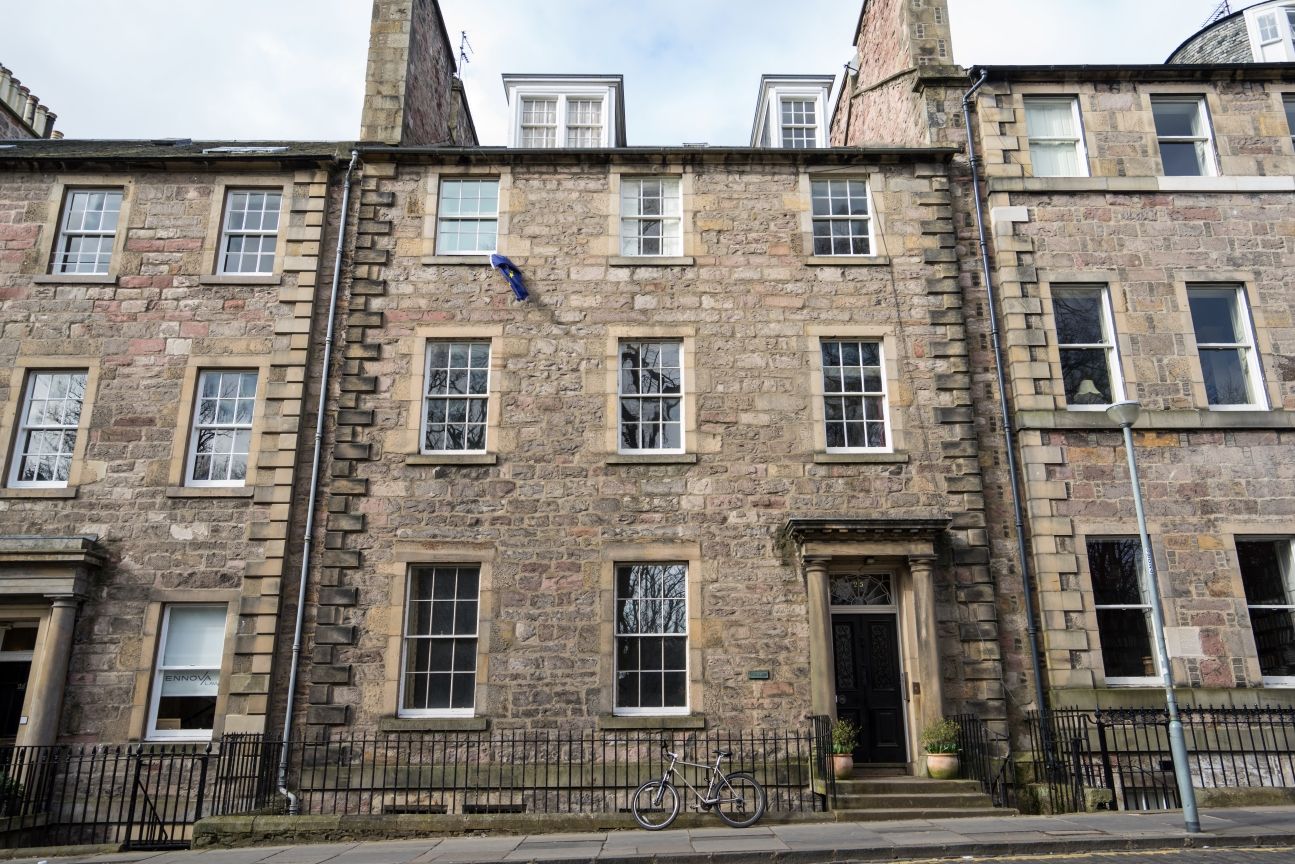
25 George Square
Edinburgh, EH8 9LD

Sir Walter Scott's childhood home and family residence.
GPS Coordinates: 55°56'35.5"N 3°11'24.5"W
Scott Connection
25 George Square was the Edinburgh home of Walter Scott and his family from 1778 until his marriage in 1797. Here he spent much of his childhood and youth, attended the Royal High School, studied at the University of Edinburgh and began his legal training.
Date Range Relevant to Scott: c. 1778–1797 (family residence, with periods spent elsewhere during his education).
Current Status
No. 25 George Square was sold by the Dominican community in 2005. The community's new chapel was subsequently built in the garden behind Nos. 23 and 24 George Square. The building at No. 25 is no longer part of the Dominican premises.
Accessibility
The building can be viewed from the street. The surrounding pavements provide access to the exterior, although access to the interior is not generally available. Exterior viewing only.
Audio guide narrated by Alasdair Hutton
Why This Place Matters
George Square was one of Edinburgh's fashionable new residential developments in the eighteenth century. Built beyond the crowded streets of the Old Town, it offered larger houses and more spacious surroundings for the city's increasingly prosperous professional families.
For the young Walter Scott, No. 25 was home during an important period of his development. His father, also named Walter Scott, was a Writer to the Signet and an established Edinburgh lawyer. The family moved here in 1778, when Scott was seven years old.
The house provides a tangible connection with the Edinburgh in which Scott grew up: a city of lawyers, scholars, writers and thinkers, where traditional Scottish culture existed alongside the intellectual and social changes of the Enlightenment.
Although Scott's later literary imagination would draw heavily upon Scotland's past, his early life was firmly rooted in the professional and intellectual world of eighteenth-century Edinburgh.
Historical Context
George Square was developed during the 1760s as part of Edinburgh's expansion southwards. It became a desirable residential address for lawyers, landowners and other members of the professional classes who were moving away from the crowded Old Town.
Scott's father was among the early residents of the square. The family moved into No. 25 in 1778, following Walter's return to Edinburgh after spending several years with relatives in the Scottish Borders.
The square was home to several prominent figures of the period. Among its neighbours were the Countess of Sutherland, Lord Braxfield, the Lord Justice-Clerk, and Henry Dundas, later Viscount Melville.
The University of Edinburgh was close by, and the surrounding area was associated with the intellectual and cultural life of the Scottish Enlightenment. The square's spacious houses and gardens offered a marked contrast to the narrow streets and closes of the Old Town.
Scott Here
Walter Scott was born on 15 August 1771 in a house in College Wynd, in Edinburgh's Old Town. After suffering from an illness that left him lame in his right leg, he spent much of his early childhood at Sandyknowe in the Borders, where he developed a lasting affection for the landscape, traditions and ballads of southern Scotland.
In 1778 he returned to Edinburgh to join his family at No. 25 George Square.
He attended the Royal High School and subsequently studied at the University of Edinburgh. His university education took place over several periods, beginning in 1783. He later returned to study law and, in 1792, qualified as an Advocate.
Scott's interests extended well beyond his formal education. He developed a fascination with Scottish history, old ballads, folklore and antiquarian objects. He began collecting coins, weapons and other historical curiosities, and became increasingly interested in the stories and traditions of the Scottish Borders.
His father, a practical and respected lawyer, hoped that his son would follow a conventional legal career. Walter, however, was already developing the interests that would eventually make him one of Scotland's most celebrated writers.
The family home at George Square remained an important part of his life until his marriage to Charlotte Charpentier on 24 December 1797. He subsequently established a separate household in Edinburgh, initially renting accommodation in George Street.
The Bigger Theme
Childhood, Education and the Making of a Writer
George Square represents an important stage in Scott's early life, linking his childhood experiences in Edinburgh with the education and interests that shaped his later career.
His years here brought together several influences: the legal profession through his father, formal education at the High School and University, and an increasingly personal interest in Scotland's history and traditions.
Scott's imagination was also shaped by experiences beyond Edinburgh, particularly his childhood visits to the Borders and his time at Sandyknowe. These experiences gave him an intimate knowledge of the landscapes, stories and people that would feature so prominently in his later writing.
The combination of urban education and a deep attachment to Scotland's past became one of the distinguishing characteristics of his work.
Literary Connections
Although none of Scott's novels is set in No. 25 George Square, the house is closely associated with the formative years of the man who would become the author of the Waverley Novels.
Some useful literary connections include:
- Minstrelsy of the Scottish Border (1802–1803) – Scott's collection of traditional ballads reflects the interest in Scottish history, folklore and oral tradition that developed during his youth.
- The Heart of Midlothian (1818) – Scott's knowledge of Scottish law, legal institutions and Edinburgh society provides an important background to this novel.
- Waverley (1814) – His first published novel brought together his interest in Scottish history, tradition and the dramatic changes taking place in society.
- Guy Mannering (1815) – The novel draws upon Scott's knowledge of the Borders, its people and its traditions.
George Square is therefore best understood as part of the background to Scott's intellectual and personal development, rather than as a direct setting for his fiction.
What to Notice On Site
- The building at No. 25: Consider its appearance as an eighteenth-century family residence and its position within the original development of George Square.
- The scale of the square: Notice the spacious layout and the substantial houses built for Edinburgh's professional families.
- The contrast with the Old Town: Compare the open surroundings of George Square with the narrow streets and closes around College Wynd, where Scott was born.
- The University connection: The proximity of the University provides a reminder of the educational opportunities available to Scott during his youth.
As you look at the building, consider the young Walter Scott growing up here, attending school and university, and beginning to develop the interests that would eventually transform Scottish literature.
Questions to Consider
- How did Scott's upbringing in Edinburgh influence his understanding of Scottish society?
- What was the relationship between his formal legal education and his later interest in history?
- How did his childhood experiences in the Borders complement his education in Edinburgh?
- To what extent can we trace the origins of Scott's literary imagination to the places in which he grew up?
Further Reading
- J. G. Lockhart, Memoirs of the Life of Sir Walter Scott.
- Walter Scott, Ashestiel Memoir, in David Hewitt (ed.), Scott on Himself (1981).
- The Edinburgh Edition of the Waverley Novels, General Editor David Hewitt.
- University of Edinburgh, Chronology of Walter Scott's Life.
- University of Edinburgh, The Homes of Sir Walter Scott.
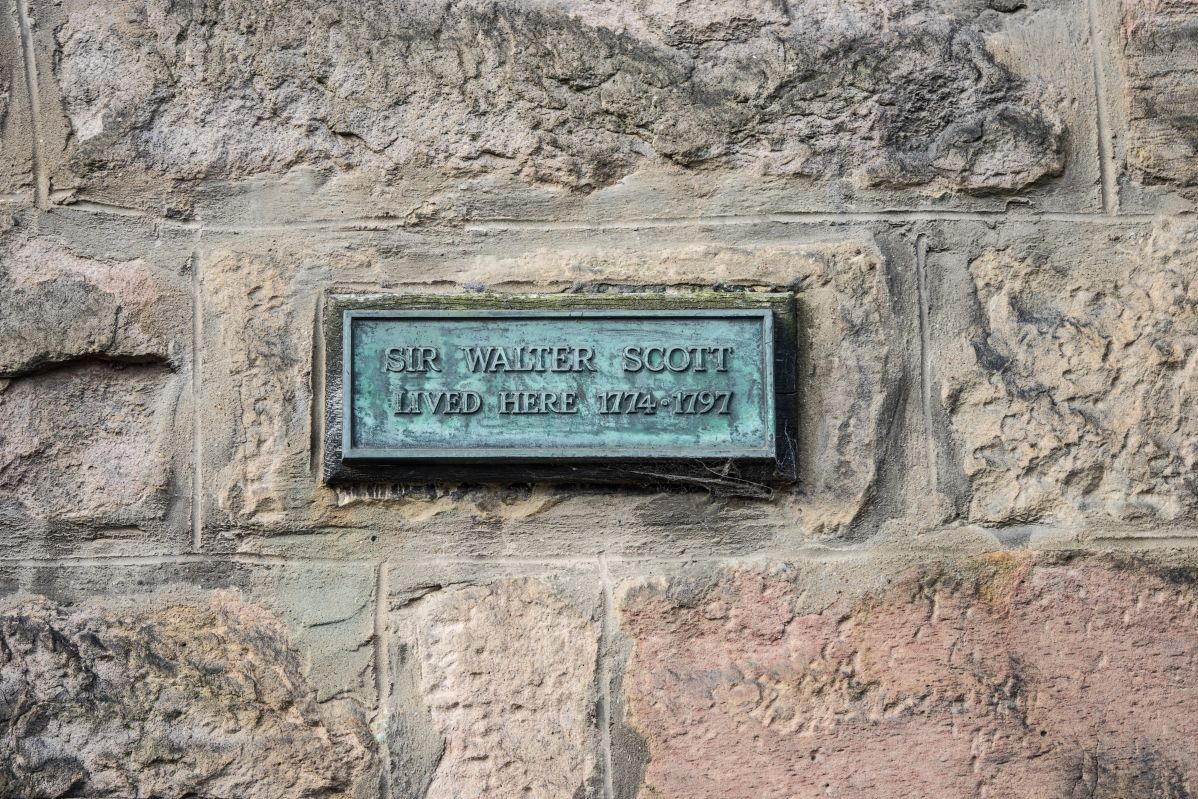
The commemorative plaque at No. 25 is the result of a collection made following the Edinburgh Sir Walter Scott Club Annual Dinner presided over by C. S. Lewis in 1956.
