

Walking Tour: Stop 5
Greyfriars Kirkyard
Candlemaker Row, EH1 1RF

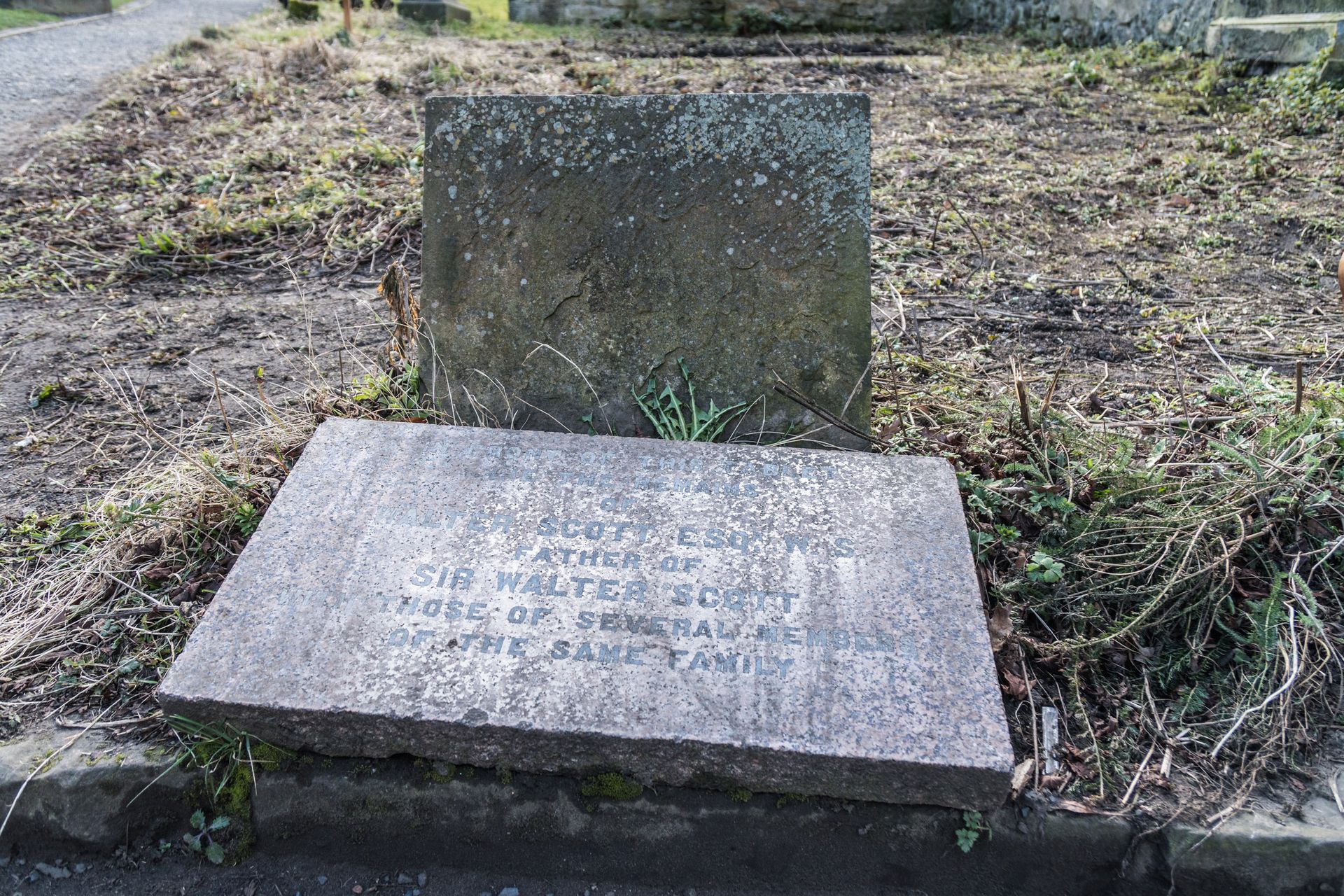
Burial place of Scott’s father and other family members.
GPS Coordinates: 55°56'47.3"N 3°11'35.0"W
Scott Connection
The burial ground containing the Scott family grave; environment shaping early urban memory.
Date Range Relevant to Scott: Late 18th–early 19th century (family burials; Scott’s lifelong proximity and emotional connection)
Current Status
Historic graveyard; open to visitors; outdoor site.
Accessibility
Street-level access; uneven historic paving; outdoor-only.
Audio guide narrated by Alasdair Hutton
Why This Place Matters
Greyfriars Kirkyard is one of Edinburgh’s most evocative burial landscapes — a place where civic history, family memory, and social conflict converge. For Walter Scott, this space was not merely a picturesque setting; it was part of his lived narrative. His own family members are buried here, including his father and brother; the stones record lineage and loss in a way that resonated with his lifelong literary concerns.
The kirkyard also embodied eighteenth-century anxieties about death, resurrectionists, and the crowded urban dead, which increasingly occupied Scottish cities before the creation of purpose-built cemeteries. Scott’s imaginative landscape — in novels such as The Heart of Midlothian — frequently returns to places where memory is physically inscribed in stone, and where civic conscience and personal grief occupy the same ground.
Greyfriars was, quite literally, part of the city Scott knew, walked, and reflected upon: not a remote idealisation, but a contested terrain of mortality written into the texture of everyday Edinburgh life.
Historical Context
By Scott’s youth, Greyfriars Kirkyard was one of the principal burial sites for Edinburgh citizens. The kirk and its surrounding yard had origins in the early seventeenth century, and by the late eighteenth century the ground was dense with monuments and gravestones.
The eighteenth century was also a period of burial anxiety in urban Britain. Population growth and inadequate burial space in cities like Edinburgh produced crowded kirkyards, re-use of lairs, and public concern about grave-disturbing activities (from the bodysnatchers who supplied anatomy schools to more quotidian fears of disrespect for the dead).
These burial landscapes, full of names and dates, became mnemonic and moral spaces — not just repositories of bones but active places of memory, conscience, and social history. They were lived spaces, not remote cemeteries.
Scott Here
Peter Garside’s blog on the Scott family graves provides the key documentary thread here. Scott’s father, Walter Scott (1729–1801), and his brother Robert appear in this kirkyard. Family plots and inscriptions would have tied the young Walter Scott to this landscape throughout his life.
Even when Scott himself was elsewhere — studying in the New Town, travelling, or living at Castle Street — Greyfriars remained part of his urban memory geography. He knew the kirk and kirkyard intimately; his repeated returns to Edinburgh would have taken him through this space.
This everyday familiarity also shaped his understanding of how communities remember and memorialise their dead — a theme that recurs in his writing.
The Bigger Theme
Memory Landscapes and Narrative Inscription
Greyfriars is a place where history is literally carved into rock. Names, dates, relationships, affiliations, ranks, and registers appear in stone — public record, private grief, and civic identity intersected here. Scott’s novels often work with similar inscriptions: stories embedded in objects, letters, tombs, legal documents, and oral testimony.
The kirkyard is not a romantic backdrop. It is a text written in stone, a civic archive from which Scott drew narrative energy — a space where memory and narrative are inseparable.
Literary Connections
• The Heart of Midlothian — This novel engages deeply with civic conscience, moral public judgment, and how communities remember justice and death.
• Old Mortality — A direct graphic engagement with inscription, preservation, and burial memory, this novel intersects with kirkyard culture.
• Redgauntlet — Evokes historical inscription and family legacy as narrative drivers.
These works reflect not only settings but the ontology of memory that kirkyards embody.
• Guy Mannering — In the novel Scott provides a graphic description of Mrs Margaret Bertram’s burial in Greyfriars, evoking disturbed ground and ancestral remains — a striking instance of the churchyard entering his fiction directly.
What to Notice On Site
• The Scott family plot and its inscriptions — stately, worn, personal
• The density of stones and closeness of lairs — horizontal and vertical memory
• Proximity to city streets — not isolated, but cross-cut by urban life
• Variations in monument style — from modest to ornate
Stand among the stones and listen — not in a ghostly sense, but in a civic and historical one.
Questions to Consider
• How does a burial ground function as a living archive?
• In what ways does public memory depend on permanence (stone) and impermanence (urban change)?
• How do Scott’s novels negotiate the tension between historical permanence and narrative transience?
Further Reading
• J.G. Lockhart, Memoirs of the Life of Sir Walter Scott
• Walter Scott, Ashestiel Memoir (in David Hewitt (ed.), Scott on Himself, 1981)
• Edinburgh Edition of the Waverley Novels (General Editor: David Hewitt)
•
Peter Garside, “The Scott Family Graves”
Official Website