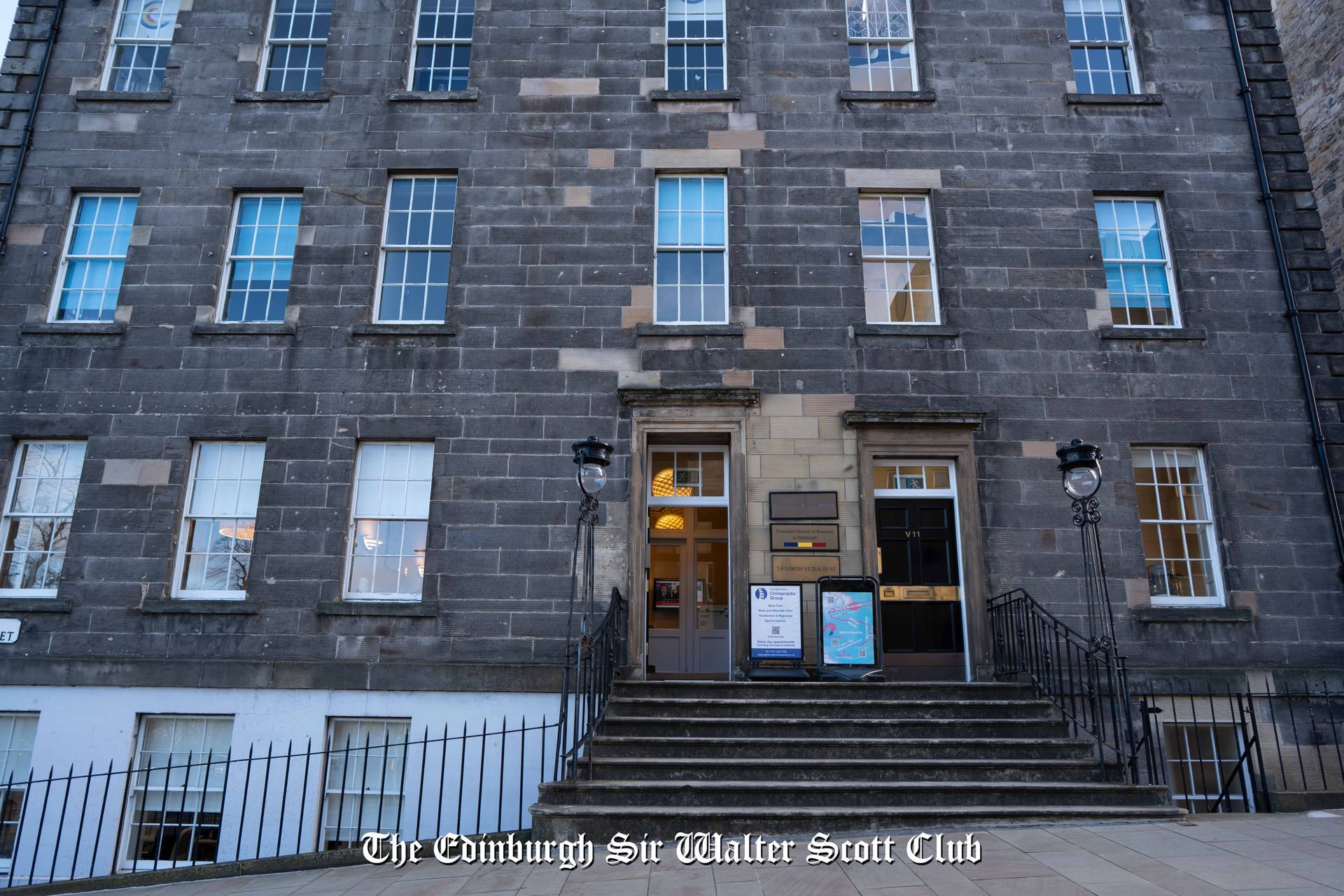

Walking Tour: Stop 15
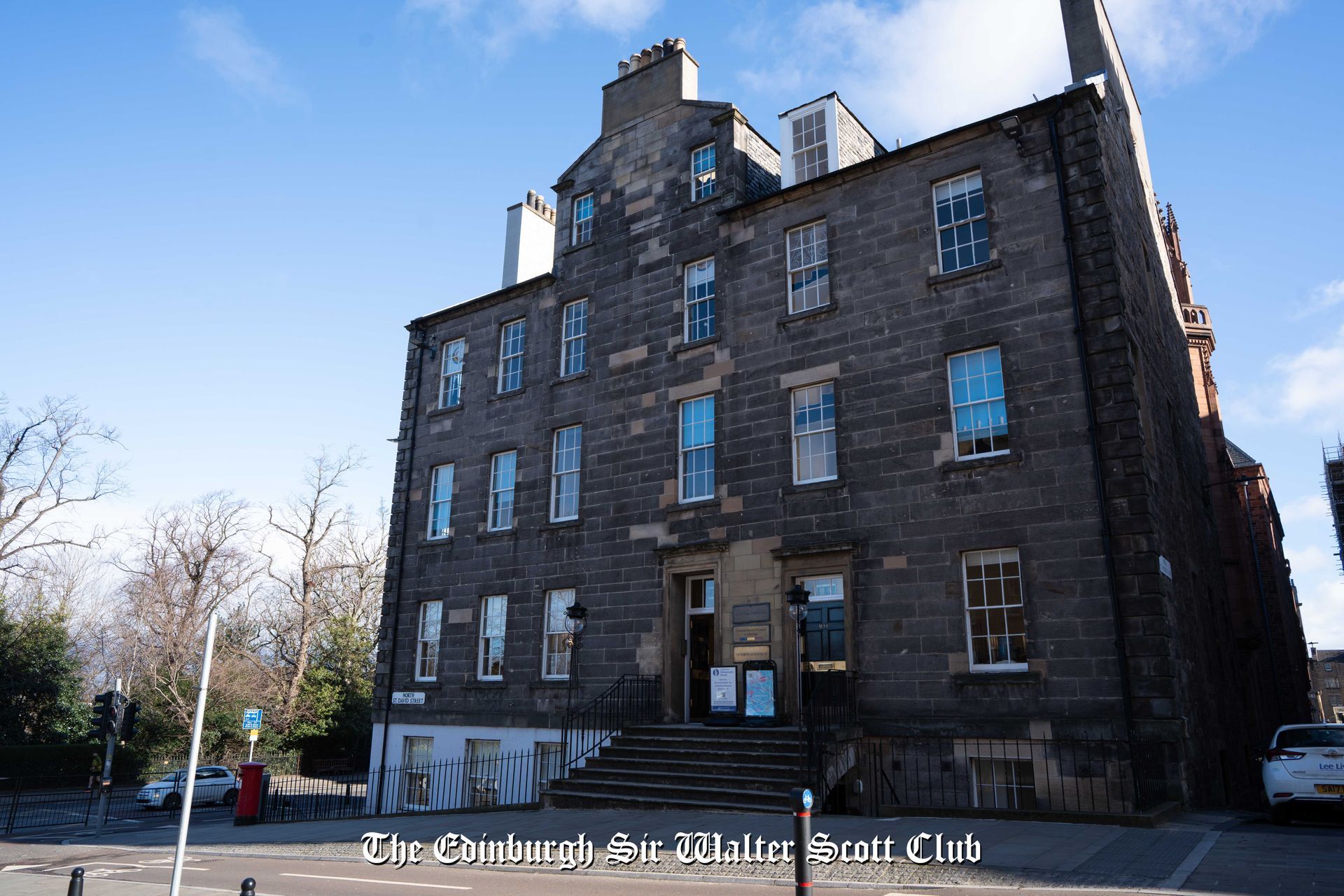
Mrs Brown’s Lodgings
6 North St David Street, EH2 1AD

Lodgings used by Scott after the financial crash of 1826.
GPS Coordinates: 55°57'19.4"N 3°11'40.3"W
Scott Connection:
Temporary lodging used by Sir Walter Scott in 1826 after the sale of his home at 39 Castle Street following the financial crash of the Ballantyne printing business.
Date Range Relevant to Scott: 12 May – 13 July 1826
Current Status:
Commercial offices; exterior view only.
Accessibility:
Not open to the public.
Why This Place Matters
Scott had no settled Edinburgh home after leaving Castle Street in March 1826. Mrs Brown’s lodging house therefore represents the beginning of a period in which he lived temporarily in the city while labouring to repay the debts created by the publishing collapse.
Rather than declaring bankruptcy, Scott chose to accept full responsibility for the enormous debts — a decision that astonished many contemporaries. During this difficult period he took lodgings here with Mrs Brown, a landlady whose accommodation offered modest but practical rooms within walking distance of the legal courts.
From these lodgings Scott continued to write with extraordinary determination, producing new works while managing the complex legal arrangements required to repay his creditors. The address therefore marks the beginning of Scott’s remarkable final literary phase, when writing became both artistic endeavour and financial necessity.
Historical Context
The financial crisis that overtook Scott in 1826 arose from the collapse of the publishing house Archibald Constable & Co. and the Ballantyne printing firm with which Scott was closely connected.
Although Scott had not directly controlled the printing business, he had guaranteed many of its debts. When the firms failed, Scott faced liabilities of more than £100,000 — a sum roughly equivalent to over £12 million today.
Instead of seeking legal protection from creditors, Scott entered into a trust agreement through which his future literary earnings would be used to repay the debt. This decision transformed the final years of his life into an extraordinary period of literary productivity.
During the early stage of this crisis, Scott moved from Castle Street to lodgings in North St David Street, remaining close to Edinburgh’s legal and publishing districts.
Scott Here
Scott arrived at Mrs Brown’s lodgings in May 1826, shortly after leaving Castle Street.
Despite the personal and financial upheaval, he maintained a disciplined working routine. From these rooms he continued writing and organising the publication of works that would gradually reduce his debts.
Scott’s journals from this period include a humorous complaint about the bedbugs in the lodgings — a moment of self-mocking humour during a period otherwise marked by intense pressure.
While living here Scott continued his close association with his publisher Robert Cadell, who later assisted in organising the publication of Scott’s collected works and the famous Magnum Opus edition of the Waverley Novels.
The Bigger Theme
Literary Labour and Moral Responsibility
Scott’s decision to repay the debts of the collapsed printing business defined the final chapter of his life. The lodgings at North St David Street symbolise the moment when Scott’s writing became a form of moral labour.
Rather than retreat from public life, he chose to confront financial disaster through sustained literary effort — producing novels, biographies, essays, and historical works with extraordinary energy.
This period reshaped Scott’s reputation, transforming him from celebrated novelist into a symbol of personal honour and perseverance.
Literary Connections
Several major works were produced during the years following the financial crash, including:
Woodstock (1826)
The Life of Napoleon Buonaparte (1827)
Tales of a Grandfather (1828–1830)
These works formed part of the sustained literary effort through which Scott gradually repaid the debts incurred by the Ballantyne partnership.
What to Notice On Site
North St David Street lies only a short distance from St Andrew Square and the centre of Edinburgh’s publishing district.
From here Scott could easily reach:
• the courts at Parliament House
• the offices of his publishers
• the social world of New Town Edinburgh.
The street illustrates how closely Scott’s working life remained tied to the professional networks of the city even during personal crisis.
Questions to Consider
How unusual was Scott’s decision to repay the enormous debts of the printing partnership rather than declare bankruptcy?
Did the pressure of debt change the character of Scott’s later writing?
Further Reading
J. G. Lockhart - Memoirs of the Life of Sir Walter Scott
David Hewitt - Scott on Himself
John Sutherland - The Life of Walter Scott: A Critical Biography
Walter
Scott - The Journal
Laurence Hutton -
Literary Landmarks of Edinburgh.
Jane Millgate -
Walter Scott: The Making of the Novelist.
Did You Know?
Scott jokingly recorded that the bedbugs in Mrs Brown’s lodgings inspired a short piece of comic verse — one of the lighter moments preserved in his Journal during the otherwise difficult year of 1826.
"To-day I leave Mrs. Brown's lodgings. Altogether I cannot complain, but the insects were voracious, even until last night when the turtle-soup and champagne ought to have made me sleep like a top. But I have done a monstrous sight of work here notwithstanding the indolence of this last week, which must and shall be amended.
So goodbye, Mrs. Brown,
I am going out of town,
Over dale, over down,
Where bugs bite not,
Where lodgers fight not,
Where below your chairmen drink not,
Where beside your gutters stink not;
But all is fresh and clean and gay,
And merry lambkins sport and play,
And they toss with rakes uncommonly short hay,
Which looks as if it had been sown only the other day,
And where oats are twenty-five shillings a boll, they say;
But all's one for that, since I must and will away."
Journal, 13th July 1828
Footnote: Contemporary sources identify Mrs Brown’s lodging house as No. 6 North St David Street, though some later references have mistakenly given the address as No. 5.