
College Wynd (Guthrie Street)

Birthplace in the Old Town Labyrinth
Address
College Wynd (Guthrie Street)
Postcode: EH1 1HT (approximate central reference)
GPS Coordinates: 55°56'52.2"N 3°11'18.3"W
Scott Connection
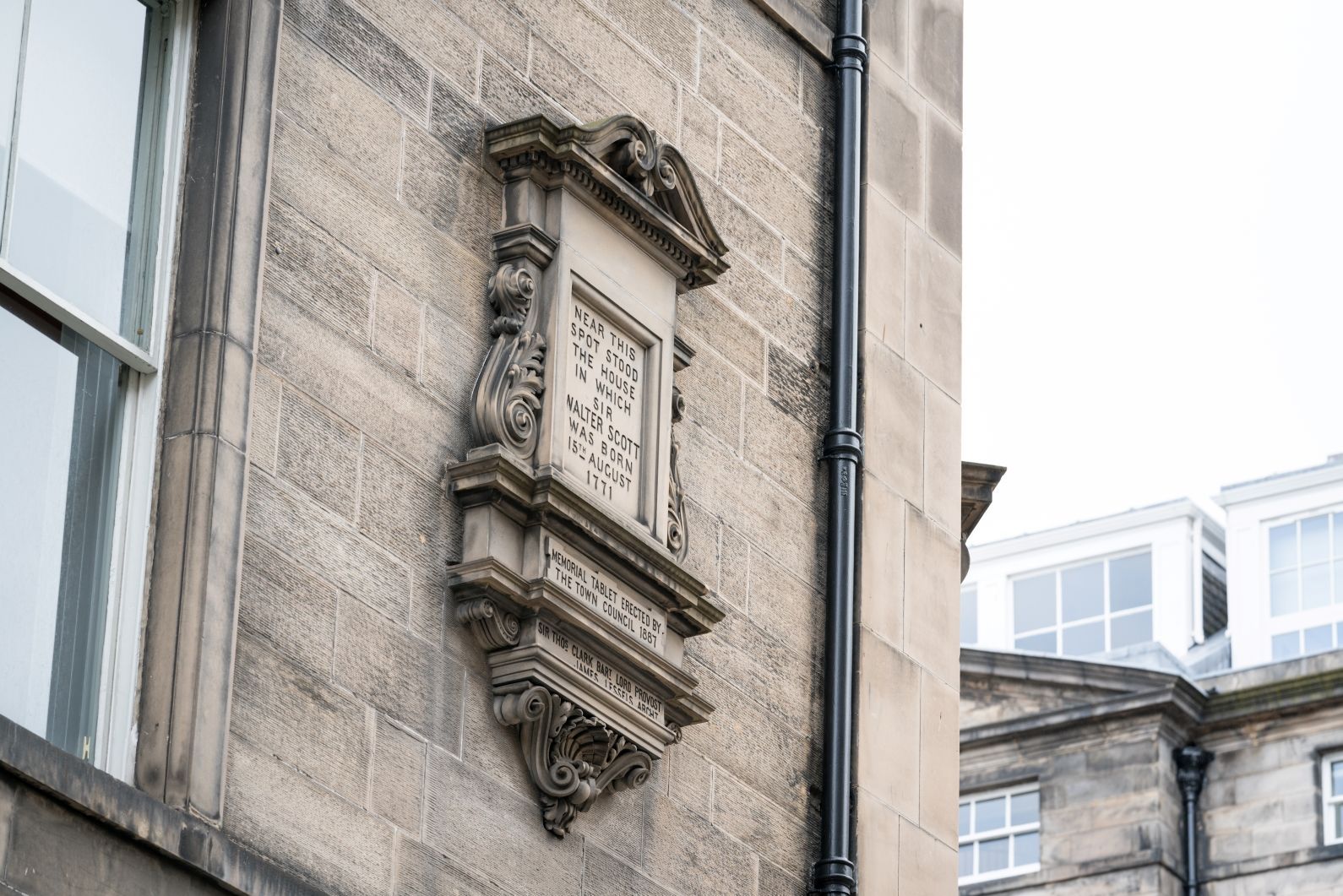
Birthplace of Sir Walter Scott, 15 August 1771.
Date Range Relevant to Scott: 1771–early childhood years before removal to the Borders.
Current Status
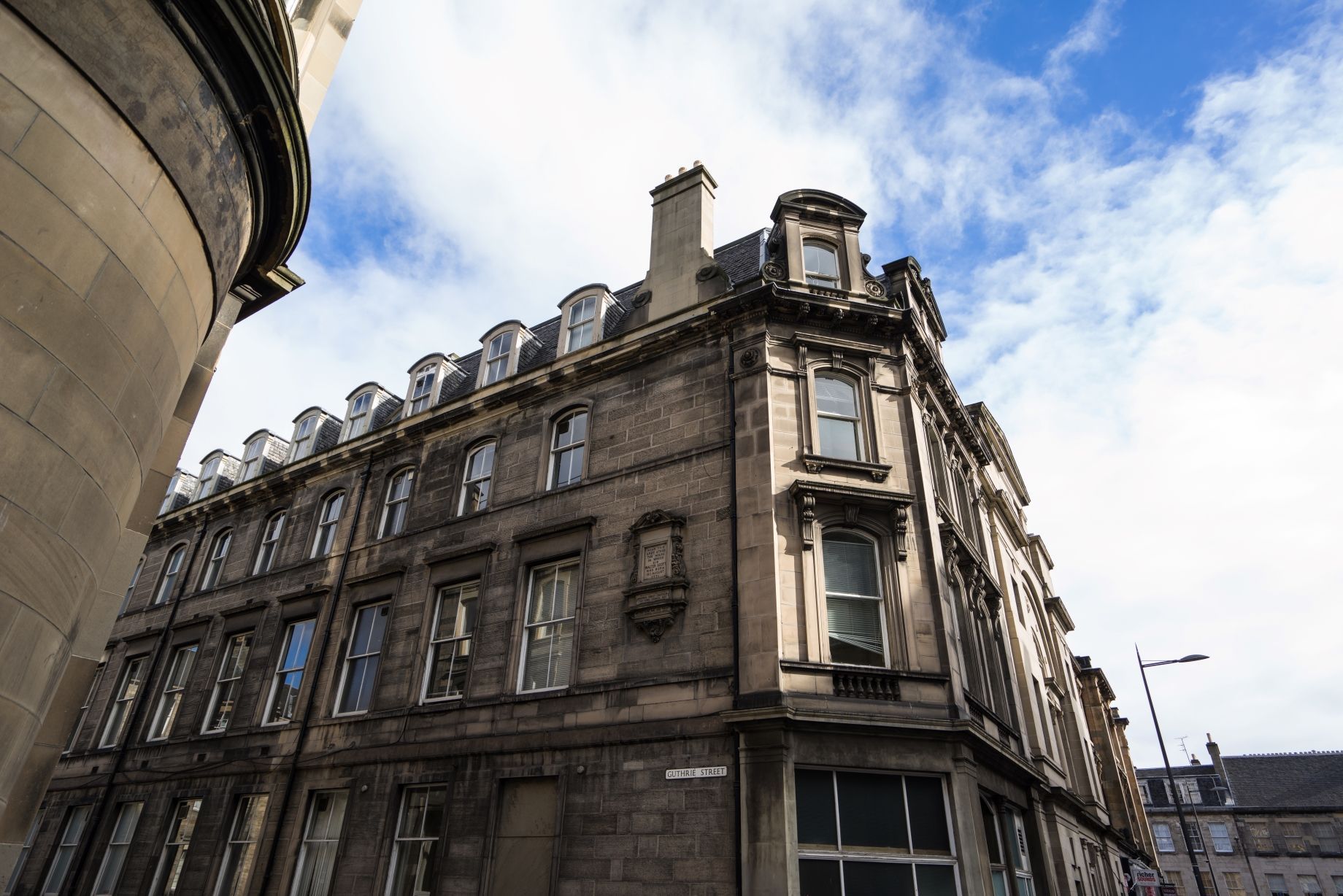
Original building demolished; commemorative plaque marks approximate site.
Accessibility
Public street access; step-free pavement; exterior viewing only.
Why This Place Matters
This is the origin point of the tour — and of Scott’s life.
Walter Scott was born here on 15 August 1771, the ninth child of Walter Scott, Writer to the Signet, and Margaret Rutherford. The house itself no longer survives. Much of upper College Wynd was cleared in the nineteenth century to make way for Chambers Street and university expansion. What remains is fragmentary, atmospheric, and layered with later redevelopment.
The loss of the building is itself instructive. Scott was born not into monumental Edinburgh, but into its crowded medieval core: a world of vertical tenements, poor sanitation, and compressed domestic life. His later literary achievement — shaping Scotland’s past into national narrative — begins in these narrow spaces.
The plaque marks memory, not masonry.
Historical Context
In 1771, the Old Town was densely populated and vertically stratified. Families occupied stacked tenements; sanitation was rudimentary; disease was common. The Enlightenment was flourishing in drawing rooms and clubs, yet much of the city’s population lived in cramped, insanitary conditions.
Scott contracted infantile paralysis (often described as polio) at around eighteen months old.
Concerned for his health, his family sent him to Sandyknowe Farm in Roxburghshire, where he was raised for several formative years in the cleaner air of the Borders.
Thus, from infancy, Scott’s life oscillated between two worlds:
- The dense, urban Old Town
- The expansive, historical Border landscape
That oscillation would define his imaginative life.
Scott Here
Scott’s earliest conscious memories were formed elsewhere — at Sandyknowe — but this street anchors his urban identity. His father’s profession as a Writer to the Signet placed the family within Edinburgh’s legal middle class, embedded in the Old Town’s professional culture.
Even before formal education, Scott grew up in a household attentive to law, documents, and historical memory. Though physically fragile as a child, he absorbed stories — first from family and Border relatives, later from the city itself.
College Wynd represents the beginning of that dual formation: Urban discipline and rural romance.
The Bigger Theme
Urban Origin and Dual Inheritance
Scott’s imagination was shaped by contrast.
From this cramped medieval birthplace he was removed to the Borders, where landscape, oral tradition, and family storytelling nurtured his sense of historical romance. Later, he would return to Edinburgh’s legal and institutional world.
His writing repeatedly stages this tension:
City and countryside
Law and legend
Modernity and memory
College Wynd is where that dual inheritance begins.
Literary Connections
Though not directly depicted in the Waverley novels, this urban density informs:
- The Heart of Midlothian — Old Town social compression and civic justice
- Old Mortality — tension between institutional authority and popular memory
- Guy Mannering — interplay between city and countryside
The city is never neutral in Scott. It is layered, contested, and morally charged — as the Old Town always was.
What to Notice On Site
Stand in the remaining stretch of College Wynd or near the plaque and observe:
- The narrowness of the lane
- The height of surrounding stone walls
- The contrast with open New Town streets visible nearby
- The shadowed quality of the space
Then compare this with North Castle Street later in the tour.
The physical difference is interpretative.
Questions to Consider
- How does beginning life in a crowded medieval tenement shape a writer’s sense of history?
- Would Scott’s imagination have developed differently had he been born in the New Town?
- How does the demolition of the birthplace building alter how we remember him?
Further Reading
J.G. Lockhart,
Memoirs of the Life of Sir Walter Scott
Andrew Lang,
Sir Walter Scott
David Hewitt (ed.),
The Edinburgh Edition of the Waverley Novels
Dr. Lucy Wood, “Scenes from the Waverley Novels”