
Walking Tour: Stop 12
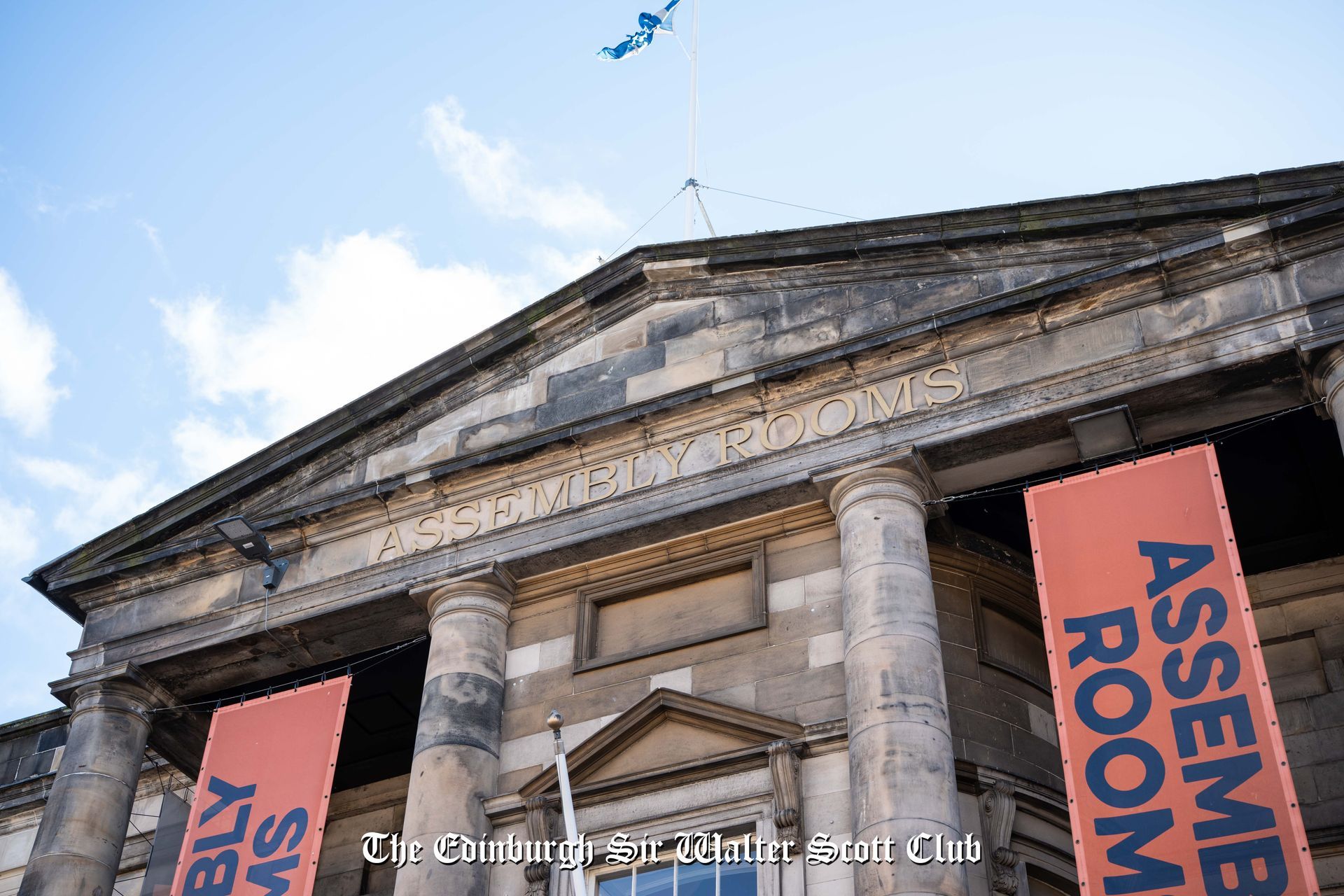
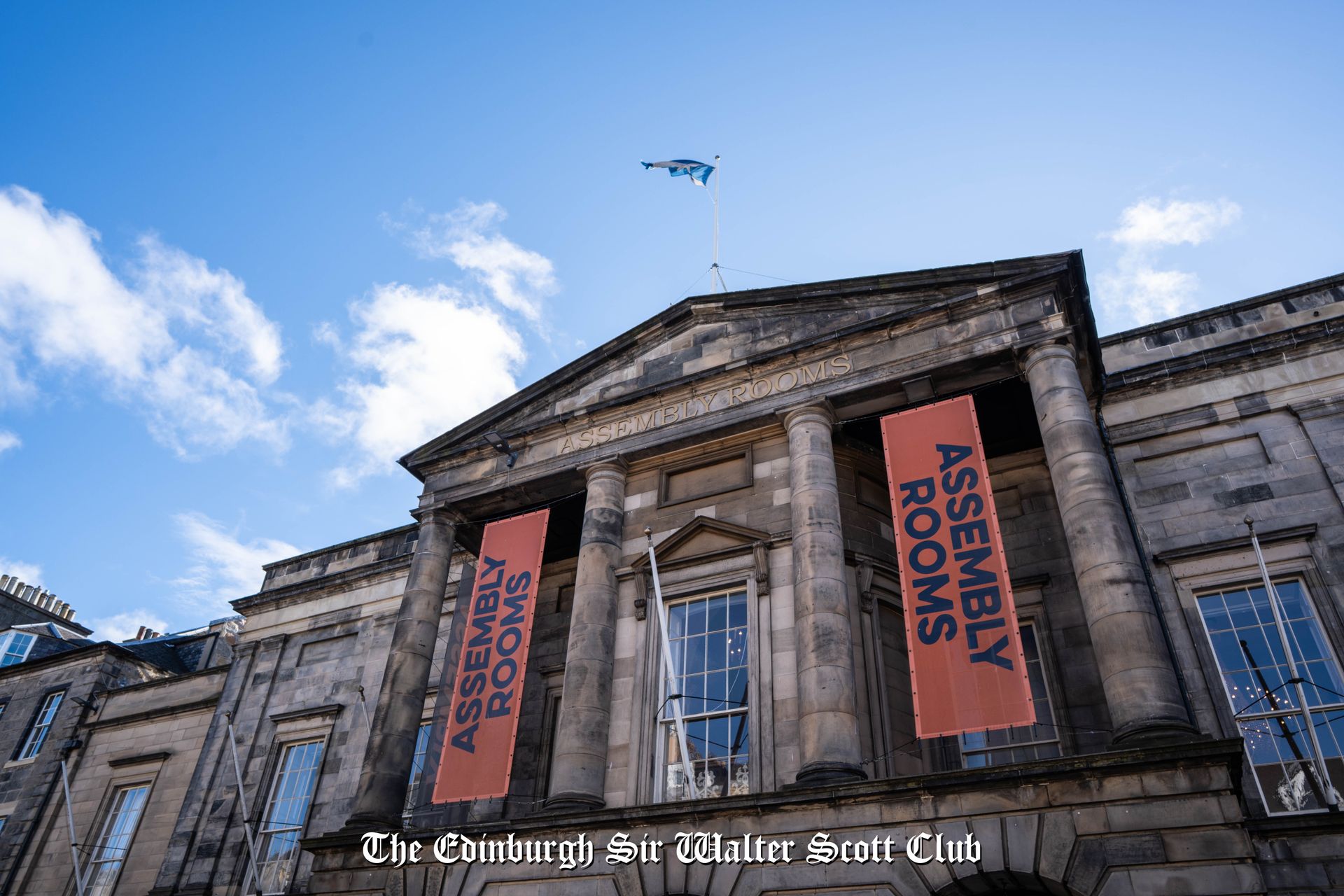
Assembly Rooms
54 George Street, EH2 2LR

Venue where Scott publicly acknowledged authorship in 1827.
GPS Coordinates: 55°57'11.3"N 3°11'55.3"W
Scott Connection:
Site of the Theatrical Fund Dinner (23 February 1827) at which Scott publicly acknowledged himself as the author of the Waverley Novels.
Date Range Relevant to Scott: Particularly 23 February 1827
Current Status:
Public events venue (City of Edinburgh Council).
Accessibility:
Modern venue; step-free access available (check official access information before visiting).
Opening Times:
Open for scheduled events; not continuously open for general viewing.
Audio guide narrated by Alasdair Hutton
Why This Place Matters
The Assembly Rooms mark one of the most dramatic public moments in Scott’s life.
On 23 February 1827, at a Theatrical Fund Dinner held here in George Street, Scott acknowledged publicly — after years of speculation — that he was indeed the author of the Waverley Novels. Though the secret had long been widely suspected, this was the first open admission.
The moment came after the financial collapse of 1826, which had exposed Scott to public scrutiny and personal humiliation. Yet when he rose to speak, he was met not with condemnation but with sustained applause.
The Assembly Rooms therefore represent not literary creation, but literary revelation.
Historical Context
The Assembly Rooms were a centre of Georgian Edinburgh’s social and civic life. Designed by John Adam and opened in 1787, they hosted balls, concerts, public dinners, and gatherings of the city’s professional elite.
By the 1820s, Edinburgh had become an international literary capital, largely through Scott’s success. The dinner held here in 1827 was organised to support actors and theatre professionals, but it became a defining cultural event in Scottish literary history.
Scott had maintained anonymity since the publication of Waverley in 1814. For over a decade, “The Author of Waverley” was one of the most famous unidentified writers in Europe. The Assembly Rooms ended that ambiguity.
Designed by John Adam and opened in 1787, the Assembly Rooms were built as a centre of polite society in the expanding New Town. They hosted subscription balls, concerts, public dinners, and civic gatherings, forming part of Edinburgh’s Enlightenment social infrastructure. By the 1820s they were the city’s principal venue for large-scale public occasions. These are not the earlier Assembly Rooms of Buccleuch Place, where Scott had appeared as a young man; the George Street building reflects the city’s later Georgian confidence.
Scott Here
Following the crash of Archibald Constable’s publishing house and the Ballantyne printing firm in 1826, Scott had assumed responsibility for enormous debts. His authorship was no longer a trivial secret; it was directly linked to financial accountability.
At the Theatrical Fund Dinner, encouraged by friends and amid mounting public curiosity, Scott stood and declared himself the author of the novels.
Accounts describe the room erupting in cheers. The revelation was received not as scandal, but as confirmation of what many already believed — and as an act of dignity.
From this moment, Scott ceased to be “The Author of Waverley” and became publicly Sir Walter Scott, novelist.
The Bigger Theme:
Public Authorship and Civic Identity
For more than a decade, Scott managed a dual identity: legal official by day, anonymous novelist by night.
The Assembly Rooms represent the collapse of that duality.
Here, private authorship became public identity. The novelist stepped fully into civic visibility. The city that had shaped his imagination now celebrated him openly.
The space of sociability — dinners, speeches, applause — became the stage upon which literary authorship was formalised.
Literary Connections
The event relates retrospectively to:
•
Waverley(1814) — the novel that began the anonymity.
•The Heart of Midlothian(1818) — emblematic of Scott’s Old Town imagination.
•Rob Roy
(1817) — popular success during the anonymous period.
The Assembly Rooms do not appear in the fiction, but they mark the historical endpoint of the anonymous Waverley authorship phase.
What to Notice On Site
• The scale of the principal ballroom.
• The acoustics — imagine the sound of collective applause.
• The Georgian symmetry and decorative refinement.
• Its position within the New Town’s ordered grid.
This is not a medieval setting; it is Enlightenment civility in architectural form.
Questions to Consider
- Why did Scott maintain anonymity for so long?
- Did the revelation enhance or diminish his authority?
- How does public authorship change literary legacy?
Further Reading
J. G. Lockhart,
Memoirs of the Life of Sir Walter Scott
David Hewitt (ed.),Scott on Himself
Jenny Uglow, Sir Walter Scott: The Making of the Novelist
Official Website